
No Maps. No Science. Just Instinct: 43,000-Year-Old Mining Site Redefines Origins of Human Enterprise
By ANI | Updated: April 28, 2026 17:10 IST2026-04-28T22:39:51+5:302026-04-28T17:10:08+5:30



VMPL New Delhi [India], April 28: In a discovery that reshapes our understanding of early human capability and economic ...
No Maps. No Science. Just Instinct: 43,000-Year-Old Mining Site Redefines Origins of Human Enterprise
VMPL
New Delhi [India], April 28: In a discovery that reshapes our understanding of early human capability and economic behavior, archaeological evidence from Ngwenya Mine in the western highlands of Eswatini suggests that humans were practicing organized mining as early as 43,000 years ago.
At the heart of this revelation lies the Lion Cavern, where prehistoric communities deliberately excavated hematitean iron-rich mineral used to produce red ochre. This activity predates previously understood timelines of structured resource extraction, pointing to a far earlier origin of organized human enterprise.
A Defining Human Decision
Long before formal science, maps, or advanced tools, early humans made a pivotal decisionto dig beneath the surface in search of value.
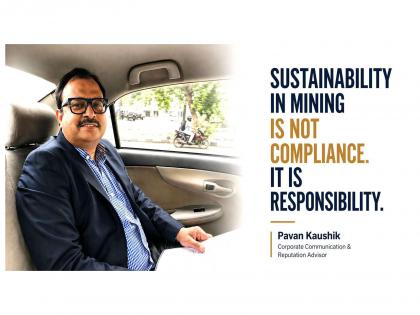
"Mining did not begin with toolsit began with judgment," says Pavan Kaushik, Corporate Communication & Reputation Advisor and author of We All Have Zinc in Our Lives.
"Someone looked at an ordinary rock face and made a non-obvious decisionthat something valuable lay within. That leapfrom observation to beliefis the foundation of every resource-driven industry today."
Beyond Survival: The Role of Ochre
The extracted hematite was processed into red ochre, a pigment widely used in prehistoric societies for body adornment, cave art, rituals, and possibly burial practices.
What makes this significant is that ochre was not essential for immediate survival.
"The extraction of ochre marks a shift from survival to symbolic value," Kaushik explains. "It reflects an early transition from utility to identityarguably one of the most defining moments in human evolution."
Early Technology, Structured Thinking
Despite the absence of modern tools, prehistoric miners used hammerstones and rudimentary picks to extract material with surprising consistency.
This process required:
* Site selection
* Material understanding
* Repetition and refinement
* Knowledge transfer
"What we see is not primitive activityit is structured execution," Kaushik notes. "This is early process engineering. Technology, at its core, is not complexityit is consistency."
Risk and Resilience in the Unknown
Mining conditions at the time were extremedark, confined spaces, no safety systems, and complete uncertainty.
Yet, early humans continued.
"This reflects a remarkable risk appetite," Kaushik adds. "Even in high-risk environments, there was a willingness to act on beliefsomething that continues to define leadership in modern industries."
The Birth of Economic Thinking
Evidence suggests that ochre was transported beyond its extraction site, indicating early forms of exchange and interaction.
"The moment a material moves beyond its origin, a system begins to form," Kaushik explains. "You see the early architecture of supply chainsorigin, demand, movement, and usage."
This positions Ngwenya not just as a mining site, but as one of the earliest indicators of organized economic behavior.
From Pigment to Progress
Over millennia, the understanding of minerals evolvedfrom pigments like ochre to metals such as iron, which would go on to shape agriculture, infrastructure, and civilization itself.
Yet, the foundation remains unchanged:
the decision to explore what lies beneath.
A Timeless Human Instinct
While modern mining relies on data, automation, and advanced technology, its core principle remains deeply human.
"Every mine still begins with belief," Kaushik says. "Technology enhances the process, but it does not replace instinct."
About the Insight
This perspective is part of ongoing thought leadership by Pavan Kaushik, who works closely with promoters and CXOs across mining, metals, and infrastructure sectors, focusing on strategic communication and reputation advisory.
(ADVERTORIAL DISCLAIMER: The above press release has been provided by VMPL.will not be responsible in any way for the content of the same.)
Disclaimer: This post has been auto-published from an agency feed without any modifications to the text and has not been reviewed by an editor
Open in app