
From Earth to Bamboo: India Pavilion at La Biennale di Venezia spotlights tribal traditions and sustainable living
By ANI | Updated: May 9, 2026 21:50 IST2026-05-10T03:19:26+5:302026-05-09T21:50:07+5:30



Venice [Italy], May 9 : India's Pavilion at the La Biennale di Venezia is drawing widespread international attention for ...
From Earth to Bamboo: India Pavilion at La Biennale di Venezia spotlights tribal traditions and sustainable living
Venice [Italy], May 9 : India's Pavilion at the La Biennale di Venezia is drawing widespread international attention for its immersive exploration of migration, memory, sustainability and indigenous knowledge systems through contemporary art rooted in traditional Indian materials and craft practices.
Remembering Home is the exhibition presented by the Pavilion of India at the 61st International Art Exhibition La Biennale di Venezia 2026. Curated by Dr Amin Jaffer and commissioned by the Ministry of Culture, Government of India, in partnership with the Nita Mukesh Ambani Cultural Centre (NMACC) and Serendipity Arts, the exhibition is installed within the historic Isolotto warehouse at the Arsenale, Venice, according to the press release.

Installed within the historic Isolotto warehouse at the Arsenale in Venice, the exhibition responds to the Biennale's overarching theme, In Minor Keys, while presenting a deeply layered reflection on identity, displacement and belonging in a rapidly changing world.
The exhibition brings together five leading contemporary artists Alwar Balasubramaniam (Bala), Ranjani Shettar, Sumakshi Singh, Skarma Sonam Tashi, and Asim Waqif whose practices reflect on the meaning of home in a time of profound transformation.

Unified through materials deeply rooted in Indian civilisation clay, thread, bamboo, papier-mache, and hand-formed natural structures the works respond to the Biennale's overarching theme, In Minor Keys.
Across the Pavilion, the idea of "home" appears fractured, suspended, scaffolded and reimagined. Together, the artists create a collective voice that remains deeply rooted in Indian cultural memory while resonating with global conversations around ecology, migration and resilience.
At the heart of Remembering Home lies a strong engagement with India's tribal and indigenous material traditions. Rather than treating tribal culture as static or historical, the exhibition transforms ancestral practices into contemporary artistic language.
Through bamboo, earth, recycled materials, embroidery and natural fibres, the Pavilion foregrounds philosophies long associated with indigenous communities sustainability, coexistence with nature, collective memory and hand-made labour.
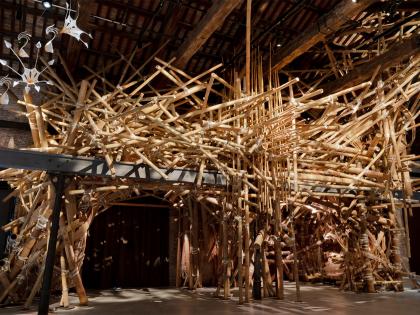
One of the Pavilion's most talked-about installations is Asim Waqif's monumental bamboo structure Chaal, inspired by temporary scaffolding systems commonly seen across India's urban landscapes.


Constructed like an evolving architectural scaffold, the immersive installation reflects themes of labour, mobility, urbanisation and the transformation of contemporary India.
At the same time, the work draws attention to bamboo's deep cultural and ecological significance within India's tribal and rural communities, particularly across Northeast India, Central India and West Bengal, where bamboo remains central to architecture, craft, basketry, food systems and local economies.
Often referred to as "green gold," bamboo continues to support livelihoods through handicrafts, textiles and women-led self-help groups across several rural regions.
The installation also subtly acknowledges the role of women as custodians of weaving, processing and artisanal traditions associated with bamboo, positioning the material not only as an ecological resource but also as a carrier of social memory and cultural continuity.
Historically, bamboo has occupied an important place within India's artistic and civilisational traditions, including its use in musical instruments, ritual practices and folk performance traditions across regions.
Within the Pavilion, bamboo emerges as both a traditional material and a contemporary response to conversations surrounding climate-conscious architecture and sustainable living.
Another significant body of work comes from Alwar Balasubramaniam, whose cracked-earth installations use soil sourced from Tamil Nadu to create surfaces shaped by natural evaporation and time.

The fissures and fragmented landscapes evoke drought patterns, ecological scars and emotional dislocation linked to migration and urban transformation.
The work also reflects indigenous philosophies where land is viewed not as property, but as ancestry, memory and spirit.
By allowing natural processes to shape the artwork, Balasubramaniam recalls ancient terracotta traditions and mud-building practices that have existed across India for centuries, embracing imperfection and transformation as part of the artistic process.
Meanwhile, Sumakshi Singh explores memory and loss through a translucent thread installation recreating the outline of a demolished family home.

Using embroidery and handwoven techniques, Singh transforms thread into fragile architectural forms that appear almost ghost-like within the exhibition space.
The work draws deeply from India's indigenous textile traditions, where weaving and embroidery historically functioned as forms of storytelling, identity preservation and oral history across tribal and rural communities.
Its labour-intensive process mirrors the slow, collective craft practices often embedded within family and community life.
The Pavilion also features works by Skarma Sonam Tashi inspired by traditional Ladakhi homes and Himalayan architectural systems.

Created using papier-mache and recycled materials, the fragile structures reflect ecological sensitivity and climate-adaptive indigenous building practices from the Himalayan region.
The installation quietly comments on the disappearance of traditional construction systems under the pressure of urbanisation and concrete development, while preserving the emotional memory of vanishing landscapes and communities.
The India Pavilion this year is themed "Geographies of Distance, Remembering Home", reflecting on migration, memory, belonging and cultural continuity in a rapidly changing world.
Union Minister for Culture Gajendra Singh Shekhawat, Secretary Culture Vivek Aggarwal, Ambassador of India to Italy Vani Rao, and Lily Pandeya Joint Secretary Ministry of Culture were also present during the inauguration event.
Over the next six months, India's cultural presence across Venice will further expand through a series of musical and performance presentations curated by the Serendipity Arts, reinforcing India's message of cultural dialogue, sustainability and creative exchange.
The inauguration of the National Pavilion of India on May 6 witnessed strong public interest and participation from diplomats, curators, collectors, artists and cultural leaders from across the world, signalling India's growing cultural footprint on the international stage.
The event hosted by the Ministry of Culture drew a distinguished gathering including H.E Sheikha Al Mayassa bint Hamad bin Khalifa al Thani, industrialists Sunil Munjal, Laxmi Niwas Mittal, Mukesh Ambani, international diplomats, artists, gallerists, art patrons and members of the global creative community. The India Pavilion has been set up by the Ministry of Culture, Government of India in collaboration with partners including Serendipity Arts Foundation and NMACC.
The strong international response to the India Pavilion reflects growing global interest in India's contemporary artistic language, traditional knowledge systems and civilisational imagination, where materials such as bamboo, thread, earth and papier-mache become symbols not merely of craft, but of resilience, sustainability and cultural confidence.
Disclaimer: This post has been auto-published from an agency feed without any modifications to the text and has not been reviewed by an editor
Open in app