
"Brutally oppressive and criminal regime": Canadian PM Mark Carney on deposed dictator Nicolas Maduro
By ANI | Updated: January 4, 2026 15:00 IST2026-01-04T20:29:58+5:302026-01-04T15:00:04+5:30


Ottawa [Canada], January 4 : Canadian Prime Minister Mark Carney on Sunday stated that one of the first actions ...
"Brutally oppressive and criminal regime": Canadian PM Mark Carney on deposed dictator Nicolas Maduro
Ottawa [Canada], January 4 : Canadian Prime Minister Mark Carney on Sunday stated that one of the first actions taken by Canada's new government in March 2025 was to impose additional sanctions on the "brutally oppressive and criminal regime" of deposed dictator Nicolas Maduro, underlining Ottawa's firm opposition to what it views as serious violations of international norms in Venezuela.
Explaining the rationale behind the move, Carney said in a post on X that the sanctions were meant to unequivocally condemn Maduro's "grave breaches of international peace and security, gross and systematic human rights violations, and corruption."
He further stressed that Canada has not recognised what he described as the "illegitimate regime" of Maduro since the 2018 election, which he said was stolen.
https://x.com/MarkJCarney/status/2007576683084169728?s=20
Linking the sanctions to Canada's broader vision for Venezuela, Carney said, "The Canadian government therefore welcomes the opportunity for freedom, democracy, peace, and prosperity for the Venezuelan people."
He added that Canada has long supported "a peaceful, negotiated, and Venezuelan-led transition process that respects the democratic will of the Venezuelan people."
Situating this stance within Ottawa's wider foreign policy approach, Carney said Canada remains committed to upholding "the rule of law, sovereignty, and human rights," and called on all parties to respect international law.
He emphasised that Canada stands by "the Venezuelan people's sovereign right to decide and build their own future in a peaceful and democratic society."
At the diplomatic level, the Canadian prime minister said Ottawa attaches "great importance to the resolution of crises through multilateral engagement" and remains in close contact with international partners as the situation evolves.
Alongside diplomatic efforts, Carney also addressed immediate humanitarian and consular priorities, saying Canada is "first and foremost ready to assist Canadians through our consular officials and our embassy in Bogota, Colombia."
He reaffirmed that the country "will continue to support Venezuelan refugees."
These comments come amid rapidly unfolding developments involving Maduro.
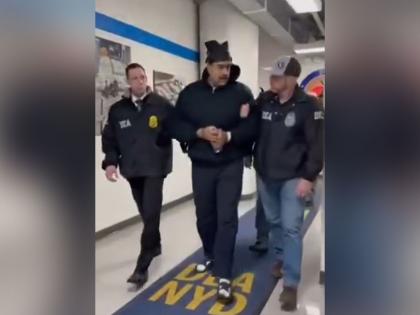
Deposed dictator Nicolas Maduro was seen wishing reporters and Drug Enforcement Administration (DEA) agents a Happy New Year and Good Night during his perp walk, footage of which was later released by US authorities showing him in handcuffs as he was led into custody.
Following his removal, Venezuela's Supreme Court moved quickly to address the leadership vacuum, ordering Vice President Delcy Rodriguez to assume the powers and duties of acting president, CNN reported.
The order, announced late Saturday night local time, concluded that Maduro was in a "material and temporary impossibility to exercise his functions."
According to the ruling read by Justice Tania D'Amelio during a session broadcast on state television channel VTV, Rodriguez will "assume and exercise, as acting president, all the powers, duties, and faculties inherent to the office of president of the Bolivarian Republic of Venezuela, in order to guarantee administrative continuity and the comprehensive defense of the nation," CNN reported.
Venezuela's constitution provides that when there is a temporary or absolute absence of the president, the vice president must replace them.
Providing additional background, former US National Security Advisor John Bolton told CNN that a plan to remove Maduro had been presented to US President Donald Trump during his first term but failed to advance because officials were unable to keep the president "focused" on the issue.
Bolton said Trump was "very interested in the Venezuelan oil" at the time, but despite efforts by his team, they "couldn't keep him focused on it."
He also said the Venezuelan opposition then believed that sustained economic pressure would be sufficient to split Maduro's regime.
According to CNN, the United States later launched what Trump described as a "large scale strike against Venezuela" and captured Maduro to face charges, carrying out the regime change effort without congressional approval.
Disclaimer: This post has been auto-published from an agency feed without any modifications to the text and has not been reviewed by an editor
Open in app