
"Enthusiasm to overturn regime incredible": Trump on Iran protests
By ANI | Updated: January 9, 2026 09:15 IST2026-01-09T14:44:03+5:302026-01-09T09:15:05+5:30


Washington, DC [US], January 9 : President Donald Trump on Thursday (local time) warned Iran's government against harming protesters, ...
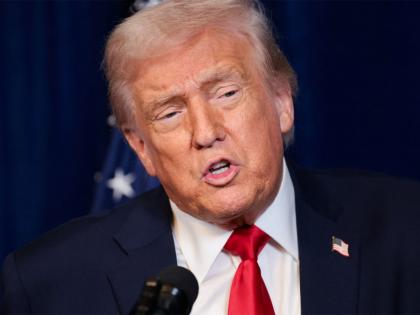
"Enthusiasm to overturn regime incredible": Trump on Iran protests
Washington, DC [US], January 9 : President Donald Trump on Thursday (local time) warned Iran's government against harming protesters, stating that the United States would intervene if innocent people were killed amid the ongoing demonstrations in the Middle Eastern country.
During an interview with Sean Hannity on Fox News, Trump said, "If they do anything bad to these people, we're going to hit them very hard," reiterating a similar warning he had issued on social media last week.
Commenting on the scale of the unrest, he added that "the enthusiasm to overturn the regime has been incredible."
Trump repeated the warning, in an interview with radio host Hugh Hewitt earlier, cautioning Iran's authorities of severe consequences if protesters are harmed as demonstrations driven by a deepening economic crisis continue to spread.
He said, "I have let them know that if they start killing people, which they tend to do during their riots, they have lots of riots, if they do it, we are going to hit them very hard."
As Trump's remarks drew global attention, protests intensified across Iran, with demonstrations spreading to multiple cities amid worsening economic conditions, according to Al Jazeera.
In Tehran, protesters set fires on the streets, while large crowds marched in cities including Borujerd, Arsanjan and Gilan-e Gharb.
Footage from the southern city of Shiraz showed security forces driving over a protest barricade carrying the message, "We revolt due to hunger."
In the capital, unrest escalated further on Thursday night after a call by the country's exiled crown prince, Reza Pahlavi, for mass protests.
Witnesses said residents poured into the streets and shouted slogans from their homes, marking a new phase of mobilisation across the Islamic Republic, Al Jazeera reported.
The demonstrations are being seen as an early test of whether the public can be mobilised following Pahlavi's appeal.
His father fled Iran shortly before the 1979 Islamic Revolution.
Several protests have included chants backing the shah, expressions that once could have carried the death penalty, reflecting the depth of anger fuelled by economic hardship and political repression, Al Jazeera reported.
Thursday's unrest followed protests that erupted on Wednesday in cities and rural towns nationwide.
Markets and bazaars closed in solidarity with the protestors.
According to the US-based Human Rights Activists News Agency (HRANA), at least 41 people have been killed and more than 2,270 detained so far, figures cited amid the widening crackdown, Al Jazeera reported.
As protests entered their second week, pressure mounted on Iran's civilian administration and Supreme Leader Ayatollah Ali Khamenei.
Iran's Chief Justice Gholam-Hossein Mohseni-Ejei issued a stern warning, blaming what he described as external influence behind the unrest.
He said, "If anyone comes into the streets for riots or to create insecurity, or supports them, then no excuse remains for them. They are now operating in line with the enemies of the Islamic Republic of Iran."
According to Al Jazeera, Mohseni-Ejei's remarks followed Trump's earlier warning last week that if Iran "violently kills peaceful protesters, which is their custom, the United States of America will come to their rescue," adding that the US was "locked and loaded and ready to go".
Those comments came months after a 12-day conflict in which Israeli and US forces bombed Iranian nuclear sites.
Support for the protesters also came from Israel, with Prime Minister Benjamin Netanyahu telling ministers, "It is quite possible that we are at a moment when the Iranian people are taking their fate into their own hands."
Following the judiciary's warning, Iran's military leadership issued its own response.
Speaking at a military academy, Major-General Amir Hatami warned of preemptive action, saying Iran would "cut off the hand of any aggressor".
He added, "I can say with confidence that today the readiness of Iran's armed forces is far greater than before the war. If the enemy commits an error, it will face a more decisive response."
As tensions rose, Iran was hit by a nationwide internet blackout, further restricting communication.
Online monitoring group NetBlocks said the disruption was detected across the country as protests continued in multiple cities.
It said the apparent shutdown followed "a series of escalating digital censorship measures targeting protests across the country and hinders the public's right to communicate at a critical moment".
Al Jazeera reported that the nationwide protests were initially triggered late last month when shopkeepers in Tehran's Grand Bazaar shut their businesses to protest the collapse of Iran's rial.
The protests unfolded amid worsening economic conditions driven by mismanagement and Western sanctions.
While authorities have not released official casualty figures, rights activists estimate that at least 36 people have been killed and more than 2,000 arrested, figures Al Jazeera said it has been unable to independently verify.
Amid the unrest, Khamenei vowed not to "yield to the enemy," comments that gained added significance following a recent US military operation that abducted Venezuelan President Nicolas Maduro, a close ally of Tehran, according to Al Jazeera.
In an effort to ease public anger, Iran's government on Wednesday announced monthly assistance of about USD 7 to offset rising prices of basic food items such as rice, meat and pasta.
The measure has been widely criticised as inadequate.
Al Jazeera quoted the New York-based Soufan Centre think tank as saying, "More than a week of protests in Iran reflects not only worsening economic conditions, but longstanding anger at government repression and regime policies that have led to Iran's global isolation."
Disclaimer: This post has been auto-published from an agency feed without any modifications to the text and has not been reviewed by an editor
Open in app