
IANS Year Ender 2025: Starting with expectations, Trump ends year knotted in controversies
By IANS | Updated: December 31, 2025 17:45 IST2025-12-31T17:41:45+5:302025-12-31T17:45:23+5:30


New York, Dec 31 The year began with expectations as President Donald Trump stepped up to lead the ...
IANS Year Ender 2025: Starting with expectations, Trump ends year knotted in controversies
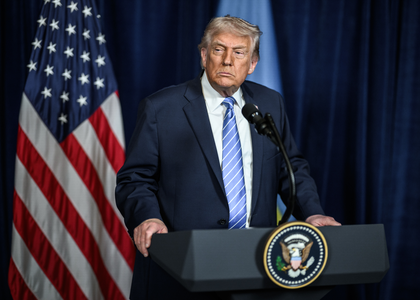
New York, Dec 31 The year began with expectations as President Donald Trump stepped up to lead the US. He, however, ended 2025 knotted in chaos and controversies.
After four years of drift under his predecessor Joe Biden, 2025 started with Trump promising decisive action. But, as the year ends, the foreign policy and the voter's personal finances are in disarray.
The US underwent a centralisation of power, perhaps unprecedented in the post-World War II era, that Trump's political, economic, trade, and, even, social policies this year seem aligned with the nation's.
The US alliances and geopolitical interests have been frayed as the mercantilists, and the geostrategists worked at cross purposes.
Yet, Trump can also point to successes that saw him emerge unscathed despite the uncertainties and high drama from the tariff war and the attempt to reset global relations.
He had phenomenal success in forcing Israel and Hamas to end the Gaza conflict.
The stock markets are ending the year at near record highs, while the GDP rose by 4.3 per cent in the third quarter of the year.
The US trade deficit also hit the lowest level in five years and brought in promises of trillions in investments to power his Make in America programme.
He also undid many of the progressive policies – some absurd like letting transgender men into women’s bathrooms and sports, and some meaningful like programmes to make up for historic injustices.
The economy emerged unscathed by the 43-day government shutdown as Democrats held up government funding in Congress over subsidies for a health insurance programme.
Trump's tariff war was marked by sudden lurches, inchoate vendetta, imposing 50 per cent tariff on India, half of that for importing Russian oil, while sparing other importers, and using it as a tool of coercive diplomacy.
It tested alliances and threw the global trade and financial systems into a welter of uncertainty.
It also showed its limitations.
At one time he threatened China with 145 per cent tariffs, only to pull back dramatically as Beijing retaliated, calling his tariff policy a "joke", and then to threaten 100 per cent tariff.
China's President Xi Jinping used rare earths and strategic minerals to make Trump back down on some of his threats, and forced him to allow the sale of some critical computer chips.
His gyrations on tariffs sent the markets on a wild ride, and introduced uncertainty.
While Trump succeeded in ending the Gaza war, Russia's President Vladimir Putin has blocked his efforts to broker an end to the Ukraine War.
His attempts to force Ukraine into a deal with Russia – at one time publicly insulting Ukraine President Volodymyr Zelensky – drew stiff resistance from the European allies who closed ranks around Kyiv, and faced down Trump.
At year's end, Putin still held him at bay.
While Trump pursued the Nobel Peace Prize claims, substantiated and far-fetched, he also launched attacks on Venezuela – a regime change operation disguised as anti-drug cartel campaign – renewed threats to attack Iran, whose nuclear facilities had been bombed, and hit Islamist targets in Syria and Nigeria.
At the government, he brought in Tesla boss Elon Musk to effect efficiencies and economies, but apart from causing confusion, it ended with Musk who had claimed he would save $1 trillion leaving the project in disarray and Washington's international influence diminished at the expense of China due to the closing of US international assistance programmes..
At senior levels of government scores, if not hundreds, who were suspected of lacking loyalty or not sufficiently enthused were fired.
Campaigns of vendetta against those who had tormented Trump in his days out of power were launched unabashedly, some like the case against New York Attorney General Letitia James failing.
A major campaign issue that vaulted him to power, illegal immigration, was also warped by confusion.
While the southern border that had been closed was further tightened, a campaign to deport illegal migrants was caught up in legal tangles, and also the attempts to arrest them were disorganised, without clarity as to who they were going after or how.
Trump, however, is also trying to restrict those coming in legally.
The H1B visa for professionals faced restrictions and $100,000 fees, and Green Cards for immigrants are on hold or delayed with new procedures.
At the same time, he is introducing 'Golden Visas' sold for $1 million.
Trump, who had once said he would give every foreign graduate of a US university a Green Card with the degree certificate, is torn on the immigration agenda by his MAGA (Make American Great Again) red-hatted base.
He also came into conflict with MAGA over the release of the files in the case of Jeffrey Epstein, a convicted pedophile, who hobnobbed with powerful people in government, business and academia.
Trump had promised to release them during his campaign, but once in office he opposed it.
With growing demands from the MAGA, who made common cause with Democrats, all Republicans in the House of Representatives but one defied him to vote for a resolution to release them.
The tens of thousands of government documents and files from the estate of Epstein who, according to officials, killed himself in jail, turned up a few tame pictures of Trump with him, but nothing compromising turned up (unlike former Democrat President Bill Clinton seen in with a bevy of women).
But the revolt in Congress drew a fault line on Trump’s firm hold on his party.
The Republican Party suffered two significant electoral defeats, losing the Virginia governorship and the city of Miami, a party fortress, sowing doubts.
Reeling from Kamala Harris's defeat last year, the Democrats fought on the "affordability" issue – the rising cost of living – and it seemed to have worked, casting an ominous shadow over the House midterm elections next year.
Even though the Democrats don’t have a coherent agenda and are torn by internal confrontations on ideology, they expect to have an edge with the "affordability" issue.
The Republican majority is razor-thin, and if three seats are flipped, they would lose the majority.
Trump fears that as it could turn the clock back to his first term when he was impeached twice.
He got his party in Texas to redraw constituency borders to give the party five more seats, but was checkmated by California, which is expected to give the Democrats a similar edge.
After spending most of the first 11 months in office flying abroad for his global agenda, the "affordability" issue has brought him down to earth.
He is giving some attention to the domestic audiences through campaign-style rallies – where he rails against Biden, blaming him for the high prices, rather than new programmes.
Disclaimer: This post has been auto-published from an agency feed without any modifications to the text and has not been reviewed by an editor
Open in app