
India urges safe maritime passage, stronger global coordination at UNSC debate on waterways security
By ANI | Updated: April 28, 2026 19:35 IST2026-04-29T01:00:36+5:302026-04-28T19:35:18+5:30



New York [US], April 28 : India underlined the need to ensure safe and unimpeded maritime passage and stronger ...
India urges safe maritime passage, stronger global coordination at UNSC debate on waterways security
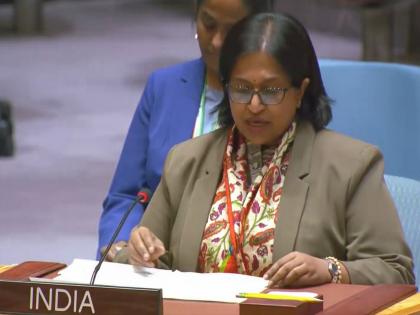
New York [US], April 28 : India underlined the need to ensure safe and unimpeded maritime passage and stronger international coordination to safeguard global waterways, reiterating its stance for free and lawful navigation amid the increasing threats and restrictions to commercial vessels in the Strait of Hormuz due to the ongoing conflict in West Asia.
Addressing the UN Security Council Open Debate on Monday, "The Safety and Protection of Waterways in the Maritime Domain", Charge d'Affaires Yojna Patel reiterated India's position, stating that the "freedom of navigation and global commerce through the Strait of Hormuz must be fully respected in accordance with international law and urges that safe and unimpeded maritime passage be restored at the earliest".
Ambassador Patel said that India remains committed to a free, open and rules-based maritime order anchored in the United Nations Convention on the Law of the Sea (UNCLOS), stressing that adherence to international law is essential for safeguarding global trade routes and ensuring freedom of navigation.
Highlighting the strategic importance of maritime corridors, the ambassador noted that disruptions in critical sea lanes have far-reaching consequences for global energy flows, trade, and humanitarian supply chains and expressed concern over recent attacks on commercial shipping in the Strait of Hormuz, calling them unacceptable and warning of risks to civilian seafarers, including Indian nationals who have lost their lives in such incidents.
"As a major trading nation, India strongly deplores the recent targeting of commercial shipping through the Strait of Hormuz and the endangerment of innocent civilian crew members. Such actions have resulted in the tragic loss of the precious lives of Indian seafarers and are unacceptable. India reiterates that freedom of navigation and global commerce through the Strait of Hormuz must be fully respected in accordance with international law and urges that safe and unimpeded maritime passage be restored at the earliest," she said.
As part of its intervention, India outlined key priorities, including strengthening the safety of navigation, ensuring continuity of humanitarian supply chains, improving maritime situational awareness, and enhancing communication channels for seafarers.
"As a responsible maritime power, India has the honour of submitting certain recommendations to alleviate the situation and contribute to the safety of waterways and seafarers," Patel added.
Presenting its recommendations, the ambassador informed the Council that the Directorate General of Shipping has set up a 24x7 helpline for seafarers of all nationalities, which has already received thousands of calls and emails, reflecting growing global maritime safety concerns.
"As of date, we have received close to 7,500 calls and more than 15,000 emails," she noted.
The Ambassador also urged greater engagement with the Information Fusion Centre - Indian Ocean Region (IFC-IOR), citing its role in maritime domain awareness and coordination and noted that increased reporting to the centre could help improve safe navigation, facilitate communication regarding seafarers, and support humanitarian logistics.
The country further flagged the environmental risks posed by attacks on commercial vessels, warning of potential maritime pollution and calling for enhanced global monitoring and coordination mechanisms.
Asserting its position as a major maritime nation, the ambassador noted that it is among the top seafarer-supplying countries globally, contributing about 13 per cent of the world's seafaring workforce. It stressed that disruptions in key waterways directly threaten global economic stability, energy security, and humanitarian supply chains.
"As a leading seafaring nation committed to global maritime safety and security, India would be honoured to receive the consideration of the member states on our recommendations that may contribute to UN and IMO specific mandates in these trying circumstances and beyond," the ambassador said.
"In conclusion, India sees maritime security and the protection of waterways as essential to global security and economic prosperity. Being among the top three seafarer-supplying nations, contributing approximately 13 per cent of the global seafaring workforce, India remains deeply concerned about the safety and welfare of its seafarers. Any disruption, obstruction, or purported closure of vital waterways has direct consequences for the global economy, energy, and humanitarian supply chains," she added.
Patel concluded by reiterating that maritime security and the protection of seafarers remain critical to global peace and prosperity, urging the international community to strengthen cooperation to ensure secure and stable waterways.
Disclaimer: This post has been auto-published from an agency feed without any modifications to the text and has not been reviewed by an editor
Open in app