
Securing US consent for nuclear-powered subs major achievement in talks with Trump: South Korean Prez
By IANS | Updated: December 3, 2025 13:40 IST2025-12-03T13:39:44+5:302025-12-03T13:40:19+5:30


Seoul, Dec 3 South Korean President Lee Jae Myung said Wednesday that having secured US approval for nuclear-powered ...
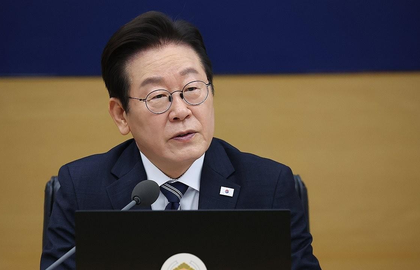
Securing US consent for nuclear-powered subs major achievement in talks with Trump: South Korean Prez
Seoul, Dec 3 South Korean President Lee Jae Myung said Wednesday that having secured US approval for nuclear-powered submarines was the major achievement of his two recent summit talks with US President Donald Trump.
Lee made the remarks during a press conference with foreign media, expressing hopes that building a nuclear-powered submarine could take place in South Korea rather than in the US, considering various economic and security factors.
"It was a highly beneficial outcome for us, from the viewpoint of strategic flexibility and autonomy," he said, Yonhap News Agency reported.
"I know President Trump has suggested building them at the Philadelphia shipyard, but from our perspective, it is realistically very difficult," he said.
Following his summit with Lee in South Korea's Gyeongju during the Asia-Pacific Economic Cooperation (APEC) forum, Trump said he had given approval to Seoul to build nuclear-powered submarines and that they will be built in the Philly shipyard run by South Korea's Hanwha Ocean.
"It is desirable that they are produced domestically, in terms of military security and from an economic perspective," Lee said.
Lee firmly dismissed concerns that Seoul's push for nuclear-powered submarines would undermine the international nonproliferation regime -- to which it is a party -- stressing that South Korea completely stands by its nonproliferation obligations.
"It is not as if a nuclear submarine has detonators or nuclear bombs in it," he said, adding that reprocessing spent fuel is not directly related to nuclear proliferation.
"Denuclearisation of the Korean Peninsula is a grand principle on which both Koreas have agreed. It (A nuclear buildup) is a senseless move. The US would never approve it, and we would end up with massive economic sanctions and become like North Korea. Do you think we could put up with that?" he said.
On Seoul's push for dialogue with North Korea, Lee said that the stalled inter-Korean ties should not block efforts to resume talks between Washington and Pyongyang, saying the US "can do a lot" to make it happen.
"North Korea has outrightly rejected our calls for talks, but there are many things that the US can do," he said. "North Korea sees the US, not South Korea, as the party that can provide security guarantees for its regime."
Lee said he is ready to help create conditions or provide "strategic leverage" to restart talks, including scaling down joint military drills with the US
"We will do our best to create objective conditions so that communication and cooperation can occur at any time. (Scaling down) The South Korea-US joint military exercises are also part of that," he said.
Lee, a liberal president, has vowed to act as a "pacemaker" to help facilitate dialogue between Washington and Pyongyang and called for Trump to be a "peacemaker" through resuming talks with the North's leader, Kim Jong-un.
Asked if he has considered apologising to North Korea for the alleged sending of anti-Pyongyang leaflets by former President Yoon Suk Yeol's government, Lee said he has thought about it but has refrained from doing so, out of concern that it could trigger an ideological clash at home.
"I have thought that perhaps I should apologise, but I haven't dared to say it because my concern is that it might be used as a tool for so-called pro-North labelling or trigger an ideological confrontation," he said.
"I don't know how you could see into my mind and ask such a question. You must have read my thoughts," Lee said, declining to elaborate further.
In a recent social media posting, Lee claimed that "a war nearly broke out" because the Yoon government tried to use martial law as a pretext to start a war with the North, and the South's military sent anti-Pyongyang leaflets first before the North sent theirs into the South.
Wednesday's press event was held as part of commemorations for the one-year anniversary of the failed Dec. 3 martial law imposition by Yoon.
On rising tensions between China and Japan, Lee said South Korea could play a mediating role, where possible, to help ease the row, emphasising that South Korea has no intention to take sides with either of the two.
"Taking sides would only escalate the conflict. This applies to both personal relationships and international relations. Rather than taking sides, it's better to seek ways to coexist," Lee said.
"Where possible, it is desirable to minimise the conflict and play a role in mediating and coordinating," he said.
Regarding China, Lee said the two countries share a relationship that "cannot be separated," in terms of geography, the economy, history and socio-cultural aspects, voicing hope to visit Beijing soon.
"Stable management (of bilateral ties with China) is crucial," he said. "I hope to visit China at an early date and hold summit talks with Chinese President Xi Jinping for broad discussions," he said.
"I believe we should also discuss cooperation for security in Northeast Asia," Lee added.
Although bilateral relations with Japan have improved in recent years, historical issues stemming from the time of Japan's colonial rule of Korea remain an "emotional" issue affecting the peoples of both countries, Lee said.
"But we should not need to give up on other areas because of this issue. We can still pursue exchanges and cooperation in the economy, security, culture, and between our peoples," he said.
Asked whether Russia could help persuade North Korea to return to dialogue, Lee said its role would be very limited due to its war of aggression against Ukraine.
Disclaimer: This post has been auto-published from an agency feed without any modifications to the text and has not been reviewed by an editor
Open in app