
US and Greenland: Understanding Trump's obsession over the Arctic island
By ANI | Updated: January 9, 2026 08:20 IST2026-01-09T13:48:53+5:302026-01-09T08:20:04+5:30


New Delhi [India], January 9 : US President Donald Trump's presidency has repeatedly been marked by a strong emphasis ...
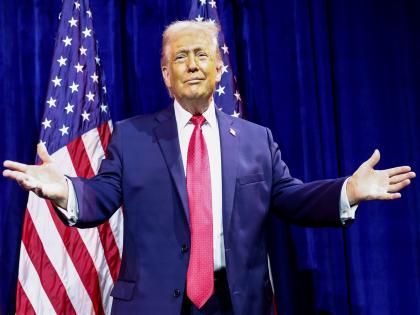
US and Greenland: Understanding Trump's obsession over the Arctic island
New Delhi [India], January 9 : US President Donald Trump's presidency has repeatedly been marked by a strong emphasis on territorial expansion and strategic dominance. Days after a US military operation in Venezuela that led to the capture of its leader, Nicolas Maduro and his wife, attention has now shifted to Greenland, with Trump once again intensifying efforts to bring the Arctic territory under American control.
The renewed push has reignited anxiety across Europe and drawn sharp criticism from several US allies. For decades, Washington has viewed Greenland as strategically important, and the Trump administration has once more placed the island at the centre of its Arctic agenda by reviving discussions around altering the status of the Danish territory.
Trump first publicly expressed interest in acquiring Greenland during his first term in 2019, likening a potential deal to a "large real estate purchase." Leaders in Nuuk and Copenhagen, however, rejected the proposal, stressing that Greenland was not for sale or transfer.
After returning to office following his victory in the 2024 US Presidential Election, Trump revived his offer from his first-term to purchase Greenland, which was again turned down.
On Tuesday (local time), the White House said it was considering "a range of options" to acquire Greenland, with Press Secretary Karoline Leavitt stating during a briefing that the use of military force was not off the table.
Leavitt said President Trump had made it clear that "acquiring Greenland is a national security priority of the United States" and was vital to deterring adversaries in the Arctic region.
"President Trump has made it well known that acquiring Greenland is a national security priority of the United States, and it's vital to deter our adversaries in the Arctic region. The President and his team are discussing a range of options to pursue this important foreign policy goal, and of course, utilizing the U.S. Military is always an option at the Commander in Chief's disposal," Karoline Leavitt said in a statement.
These developments have renewed questions about why successive US administrations have returned to the idea of acquiring Greenland and how deeply embedded American ambitions are in the island's modern history.
In the late 19th century, after buying Alaska in 1867 from the Russians, US expansionists such as then Secretary of State William H Seward floated the idea of adding Greenland and Iceland to the American sphere. In 1946, President Harry Truman's administration made the first formal bid, proposing to pay Denmark 100 million dollars in gold, partly even discussing swaps involving Alaskan territory. Denmark, however, refused to sell the island.
Why is Greenland central to Trump's Arctic strategy?
Greenland's importance lies in both its strategic location between the US, Europe and Russia and its vast natural resources. According to the Geological Survey of Denmark and Greenland (GEUS), the island holds an estimated 36.1 billion tonnes of rare earth elements. Economically recoverable reserves are estimated at about 1.5 million tonnes, according to the US Geological Survey (USGS).
GEUS has also identified deposits of graphite, lithium and copperminerals defined by the International Energy Agency (IEA) as critical for the global energy transition. While Greenland's copper reserves are limited, its uranium resources are considered strategically significant, though mining has been banned since 2021. The island currently hosts two active mines, including the Nalunaq gold mine operated by Canadian firm Amaroq Minerals.
As per the National Geological Survey, it is estimated that graphite resources in Greenland are at six million tons, which is approximately 0.75 per cent of the global total calculated by the USGS.
As for lithium, also a component in batteries and whose demand the IEA says could increase eightfold by 2040, Greenland's resources have been estimated at 235,000 tonnes, which is approximately 0.20 per cent of the global figure.
Greenland's copper resources, meanwhile, are insignificant on a global scale, but its uranium reserves, a coveted nuclear fuel, could be of greater strategic interest.
In 2023, the European Union signed a Memorandum of Understanding with Greenland to support the development of its mineral resources, highlighting the island's growing role in global supply chains as the Arctic warms at nearly four times the global average. Greenland may also hold hydrocarbon reserves equivalent to over 28 billion barrels of oil, although no industrial drilling is currently underway.
In 2023, the European Union, which identified 25 of the 34 minerals on its official list of critical raw materials in Greenland, signed a Memorandum of Understanding (MoU) with Greenland to support the development of its mineral resources, highlighting the island's growing role in global supply chains as the Arctic warms at nearly four times the global average.
The island could also hold hydrocarbons roughly equivalent to 28.43 billion barrels of oil, according to GEUS, Greenland's National Oil Company (Nunaoil), and Greenland's Mineral Resources Authority, based on industry data.
Although seemingly abundant, there has been no industrial drilling for oil or gas in Greenland, although three oil exploration licenses are active in the east of the territory. Which answers our very question: "Why is the US keen on acquiring Greenland?"
Meanwhile, on January 6, in a letter released by the Danish Prime Minister's Office on X, the leaders reaffirmed Greenland's status within the transatlantic alliance, stating, "The Kingdom of Denmark - including Greenland - is part of NATO."
Foreign ministers of Denmark, Finland, Iceland, Norway and Sweden have also jointly reaffirmed their collective commitment to preserving security, stability and cooperation in the Arctic, underscoring their support for a stronger and more vigilant NATO presence in the region.
The Nordic foreign ministers, in a statement, said that as Nordic countries, Arctic states and NATO allies, they are united in their approach to regional security, particularly amid evolving strategic challenges in the Arctic.
In a response to the NATO Joint Statement, US President Trump, on January 7, launched a sharp attack on the intergovernmental military alliance, the North Atlantic Treaty Organisation (NATO), claiming that the alliance depended entirely on Washington for its survival, shortly after European leaders pushed back against his remarks on taking over Greenland and reaffirming NATO unity.
In a post on Truth Social, Trump said that before his intervention, most NATO members were not meeting their defence spending commitments and were relying on Washington to shoulder the burden.
The US President stated that he pushed NATO members to raise defence spending to 5 per cent of GDP, asserting that allies now pay "immediately" because of his personal influence.
"Remember, for all of those big NATO fans, they were at 2% GDP, and most weren't paying their bills, UNTIL I CAME ALONG. The USA was, foolishly, paying for them! I, respectfully, got them to 5% GDP, AND THEY PAY, immediately. Everyone said that couldn't be done, but it could, because, beyond all else, they are all my friends," Trump said.
Taken together, Trump's renewed push for Greenland, the island's vast resource potential and its strategic importance to Arctic security have transformed a long-standing US ambition into an active flashpoint for NATO and the broader transatlantic alliance, with Germany now also voicing concern over any unilateral American move on the island.
Disclaimer: This post has been auto-published from an agency feed without any modifications to the text and has not been reviewed by an editor
Open in app