
Over 20,000 revenue cases cleared, land worth Rs 2,325 crore freed: Gujarat officials
By IANS | Updated: May 7, 2026 00:25 IST2026-05-07T00:21:09+5:302026-05-07T00:25:07+5:30



Gandhinagar, May 7 Large-scale land recovery, action against illegal mining and the disposal of more than 20,000 revenue ...
Over 20,000 revenue cases cleared, land worth Rs 2,325 crore freed: Gujarat officials
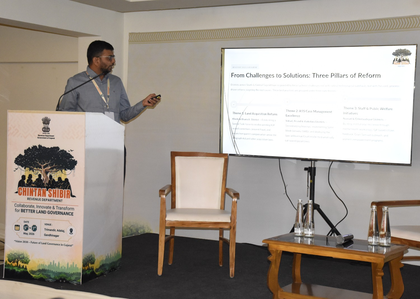
Gandhinagar, May 7 Large-scale land recovery, action against illegal mining and the disposal of more than 20,000 revenue cases within a year were highlighted as key outcomes of district-level governance initiatives presented at the Gujarat government's ‘Chintan Shibir’.
During a special session on Saurashtra and Kutch, Junagadh Collector Anil Ranavasiya delivered a detailed presentation on administrative performance across the region, stating that “through administrative transparency and strict legal implementation, services have been delivered to the last person.”
He said encroachments posing risks to public safety had been removed, resulting in the recovery of government land worth approximately Rs 2,325 crore.
Over the past two years, 37 hectares of land valued at Rs 20 crore were made encroachment-free through ‘Sarpanch Samvad’ and the resolution of village-level issues.
"Historical Harappan-era sites had been recorded, while 6,037 acres of land were earmarked for ponds and 210 acres for sports grounds," he noted.
Detailing enforcement measures, Ranavasiya cited action in Surendranagar district where 15,000 metric tonnes of illegally mined coal were seized and 2,976 acres of land freed.
He said the operation drew on 17 legal provisions, including the Bharatiya Nagarik Suraksha Sanhita (BNSS), 2023, and land-grabbing laws, describing it as a significant outcome in curbing illegal mining activities.
He also pointed to the use of the PM Gati Shakti portal and GIS technology in Jamnagar to improve accuracy in land grabbing and land allotment cases, and highlighted Botad district’s “Connect @ Botad Podcast” initiative, which enables direct engagement between the administration and residents.
Other measures outlined included Rajkot district’s ‘Swagat Audit Mechanism’, under which applicants are contacted telephonically to obtain feedback, and Gir Somnath’s full coverage under the ‘Nikshay Mitra’ initiative as part of the TB-Free India campaign.
Ranavasiya further noted that free residential plots had been allocated to nomadic and denotified tribe families in Bhavnagar, Porbandar and Botad.
In a separate ‘Best Practice Session’ on Central Gujarat, Vadodara Collector Anil Dhameliya presented administrative reforms across the region, stating that “special drives were undertaken to simplify land acquisition processes and resolve pending issues.”
He said these efforts led to the successful disposal of around 20,000 revenue cases within a year, reflecting improved administrative efficiency.
The session also highlighted Anand district’s use of QR codes to collect public feedback on government services, alongside direct public engagement through gram sabhas.
Dhameliya said these approaches had strengthened communication with residents and improved service delivery. "Steps had been taken to make Jan Seva Kendras more convenient and citizen-centric," he noted.
Discussions at the Shibir emphasised the need to expedite land-related case disposal, farmer verification processes and hearings under Section 63-AD, the SARFAESI Act and the Telegraph Act.
Officials also examined new methods to ensure timely decisions in complex legal matters, along with improvements in city survey operations, administrative authority structures and coordination among agencies, with the stated aim of delivering revenue services more efficiently and transparently.
Disclaimer: This post has been auto-published from an agency feed without any modifications to the text and has not been reviewed by an editor
Open in app