
India’s nuclear generation hits all-time high this year
By IANS | Updated: December 10, 2025 13:45 IST2025-12-10T13:40:17+5:302025-12-10T13:45:18+5:30


New Delhi, Dec 10 The Nuclear Power Corporation of India Limited (NPCIL) has achieved the highest generation in ...
India’s nuclear generation hits all-time high this year
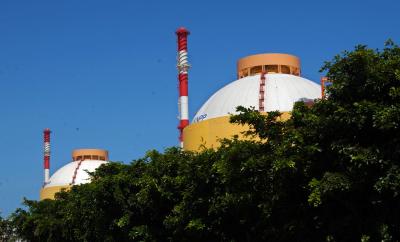
New Delhi, Dec 10 The Nuclear Power Corporation of India Limited (NPCIL) has achieved the highest generation in its entire operating history -- 56,681 million units of electricity in FY 2024-25, avoiding about 49 million tonnes of CO2 emissions, the government said in a year-end review of Department of Atomic Energy on Wednesday.
The continuous operation for more than a year has been recorded 53 times so far, with Tarapur Atomic Power Station (TAPS) exceeding its earlier record of 521 days and Kudankulam Nuclear Power Plant (KKNPP) operating more than a year, said the government.
Department of Atomic Energy (DAE) has continued to deliver on its mandate of producing nuclear power, capacity building for nuclear power, creation and operation of research reactors and particle accelerators for radio-isotope and radio-pharmaceutical production, application of radiation technology solutions to address societal issues in areas of health care, food security, water and waste management.
This year, Prime Minister Narendra Modi laid the foundation stone for the 4-unit Mahi Banswara NPP in Rajasthan in September, to be deployed by NPCIL-NTPC JV, named ASHVINI.
NPCIL also crossed the milestone of 50 billion Units (BUs) generation in a financial year for the first time in its entire operation history. Atomic Energy Commission (AEC) has given approval for pre-project activities for an additional 10 units of 700 MWe PHWRs; over and above the 22.5 GW capacity planned by 2032, according to the government.
The 150-bed Homi Bhabha Cancer Hospital and Research Centre, Muzaffarpur, Bihar, was inaugurated by Prime Minister this year.
Indigenously developed Certified Reference Material (CRM) named ‘Ferrocarbonatite (FC) – (BARC B1401) was formally released this year, which is first such CRM in India and the fourth in the world and crucial for REEs ore mining.
DAE has set-up the first electronics-grade (99.8 per cent purity) Boron-11 Enrichment Facility at Talcher, suitable for semiconductor applications.
Moreover, electron beam-based sterilization facility at Indore, Madhya Pradesh is continuously providing e-beam sterilization services to medical device manufacturers in compliance with ISO standards.
In the month of September, the facility successfully completed cumulative sterilization of 1.53 crore medical devices. A High-Intensity Gamma Irradiator with Category II type design, ISOMED 2 was completed in May 2025 to serve healthcare industry for terminal sterilisation of healthcare products. ISOMED 2.0 is the only High Intensity Land Based Stationary Gamma Irradiator in the world today.
Nuclear Fuel Complex (NFC) has successfully developed the technology for production of high Residual Resistivity Ratio Niobium ingots and sheets. This material is a critical material required for a range of advanced accelerator programs and is aimed at strengthening India’s capabilities in materials research for critical applications.
Towards Internal Security, ECIL has successfully developed, integrated and installed Chemical, Biological, Radiological and Nuclear (CBRN) System for protection from threats at vital installation. Also, first production module for Akash-Prime system, capable of 360 degree engagement of multi directional attacks from enemy aircrafts/drones, have been integrated.
Disclaimer: This post has been auto-published from an agency feed without any modifications to the text and has not been reviewed by an editor
Open in app