
Young Visionary Kaushal Ottem Declines Venture Capital to Build Neuroverse, A Global Social Enterprise Reimagining Neurological Care
By PNN | Updated: March 14, 2026 12:40 IST2026-03-14T18:09:59+5:302026-03-14T12:40:07+5:30



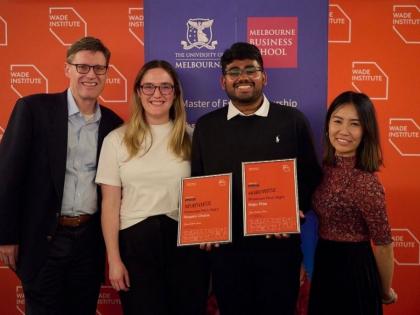
Kaushal Ottem with judges, winning the people choice and major price award for Neuroverse New Delhi [India], March 14: ...
Young Visionary Kaushal Ottem Declines Venture Capital to Build Neuroverse, A Global Social Enterprise Reimagining Neurological Care
Kaushal Ottem with judges, winning the people choice and major price award for Neuroverse
New Delhi [India], March 14: When venture capital firms began approaching Kaushal Ottem with funding offers, the young founder found himself at a moment most startups aspire to reach. Accelerators were ready, investors were preparing term sheets, and conversations revolved around scale, valuation, and rapid expansion. For many founders, this stage signals the beginning of aggressive growth.
Ottem, however, chose a different path.
Instead of pursuing capital-driven acceleration, he paused to reconsider the purpose behind his work. Neuroverse, the organisation he had begun building, was never intended to become another high-velocity startup. It emerged from direct encounters with families living with neurological conditions who were struggling to navigate a fragmented healthcare system that demands constant coordination across doctors, therapists, schools, and workplaces.
Ottem's unconventional journey began long before investors entered the picture. At just eighteen, he had already completed his Master's degree, placing him among a rare group of academic achievers far ahead of most of his peers. Corporate careers, global opportunities, and financial success were well within reach.
Yet his attention gradually shifted toward a deeper concern.
Through his interactions with families managing chronic neurological disorders, Ottem observed how parents were not only following treatment plans but also juggling therapy schedules, negotiating with schools, confronting social stigma, and worrying about uncertain futures for their children.
One mother's question remained etched in his memory.
Her concern was simple yet profound: would her child ever receive the same opportunity to learn, grow, and participate in society as everyone else?
The more Ottem observed these realities, the clearer the systemic gaps became. While healthcare innovation continues to advance globally and specialist care is expanding, families are often left to coordinate complex systems on their own. Education, therapy, healthcare management, and future employability rarely function as a connected support structure.
This fragmentation became the foundation of Neuroverse.
What began as an idea is now being tested through a pilot network involving more than 1,000 patients and over 250 neurocare teams across Oceania. The initiative is developing integrated care frameworks and digital infrastructure designed to simplify long-term neurological care coordination for families who would otherwise face a complicated and exhausting process.
As funding conversations intensified, Ottem recognised a conflict that many founders rarely confront directly.
Venture capital can accelerate growth, but it can also reshape incentives. Investor timelines and financial expectations often influence decision-making, particularly in sectors where rapid returns are prioritised.
In lifelong healthcare systems, however, alignment with families and communities is essential.
Ottem realised that if valuation became the primary metric, the people Neuroverse was created to serve could gradually become secondary. Rather than building a startup aimed at quick exits or acquisition cycles, he chose to transform Neuroverse into a social enterprise built on open infrastructure.
Care pathways, education continuity models, and employment integration frameworks are being documented so that communities and institutions can adopt them without restrictive licensing barriers.
This philosophy has expanded Neuroverse far beyond conventional healthcare services.
Ottem and his team are developing technology platforms that support life management for individuals living with neurological conditions. At the same time, the organisation is forming partnerships with businesses willing to design inclusive workplaces and provide meaningful employment opportunities.
For many families, neurological conditions affect far more than medical treatment. They shape educational continuity, personal independence, social participation, and long-term career possibilities.
Neuroverse approaches these realities as interconnected challenges, focusing on systems that enable individuals to continue learning, build skills, and contribute economically despite medical barriers.
To ensure that its solutions reflect lived experiences rather than theoretical planning, Ottem has embarked on a six-month listening journey across communities in Asia and Oceania. During this initiative, he is engaging with more than 3,500 families to document patterns in care coordination, access to education, and barriers to employment.
These insights are being translated into openly accessible frameworks that communities and organisations can adopt independently.
In a global startup ecosystem often defined by valuation milestones and investment rounds, Kaushal Ottem has chosen a different measure of success.
If Neuroverse fulfils its vision, its legacy will not be measured by capital raised, but by classrooms that remain open to every child, workplaces that recognise overlooked talent, and families who no longer have to navigate complex healthcare systems alone.
Disclaimer: This post has been auto-published from an agency feed without any modifications to the text and has not been reviewed by an editor
Open in app