
22 years of 'Main Hoon Na': A lookback at Shah Rukh Khan starrer that still charms the audience
By ANI | Updated: April 30, 2026 20:10 IST2026-05-01T01:36:41+5:302026-04-30T20:10:11+5:30



Mumbai (Maharashtra) [India], April 30 : Back in 2004, when Farah Khan's directorial debut 'Main Hoon Na' opened in ...
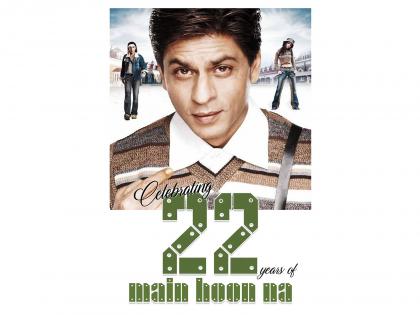
22 years of 'Main Hoon Na': A lookback at Shah Rukh Khan starrer that still charms the audience
Mumbai (Maharashtra) [India], April 30 : Back in 2004, when Farah Khan's directorial debut 'Main Hoon Na' opened in theatres, only a few would have imagined that the film would evolve into one of Bollywood's beloved entertainers.
22 years later, today, 'Main Hoon Na' stands as a clear blend of nostalgia and cinematic joy - proving that a simple masala film can outlive generations and attain cult status.
View this post on Instagram
As the film clocks 22 years of its release, let's revisit the unforgettable memories of 'Main Hoon Na'.
'Main Hoon Na' plot
Set against a backdrop of Indo-Pak peace efforts, the film follows Major Ram Sharma (Shah Rukh Khan), who is assigned a dual mission to protect Amrita Rao and reunite with his estranged half-brother Lakshman (Zayed Khan).
Disguised as a college student, Ram is seen navigating campus life while exploring new bonds, all while racing to stop the vengeful Raghavan (Suniel Shetty).
Shah Rukh Khan, as Major Ram Sharma, brings his effortless charm to the narrative, effortlessly balancing patriotism with romance as well as comedy.
He is joined by Sushmita Sen as the stunning Chandni, who eventually became a cultural icon - thanks to her flowy chiffon sarees, slow-motion entries and that captivating allure.
Actors Zayed Khan and Amrita Rao brought a youthful charm to the story, while Suniel Shetty, as the fierce antagonist Raghavan, delivered a memorable performance, further elevating the stakes.
It is worth mentioning that the popularity of 'Main Hoon Na' grew tremendously over the years, making it among the favourite rewatches. From the slo-motion introduction of Chandni to Ram Sharma's heroic actions to save Lakshman, the sequences continue to echo in fan circles.
The Iconic Scenes
* With that said, the terrace rescue is one of the most gripping scenes that unfolds on the college terrace, when Major Ram steps in as the protector for Lakshman. Blending emotions with action, the scene marked a subtle beginning when the brothers' fractured relationship starts to heal.
* In yet another Bollywood-style action, Ram's chase through the crowded scenes on a cycle-rickshaw clearly turned the everyday setting into a full-blown action piece.

* On the softer side of romance, Ram and Chandni's first meeting remains a fan favourite to date. Staged like a proper romantic fantasy inside Ram's head, the scene unfolds to show Chandni walking across the college campus draped in her signature saree, and that's when the imagination kicks in. Ram amusingly breaks into a song, appearing smitten and completely swept away by her presence.

* One of the most talked-about-sequences arrived when Ram shoots at Chandni's saree to save her, only to reveal his identity in front of her. With a pure cinematic flair and much drama, the sequence became quite recognisable among viewers.

The Music
The film's music played a crucial role in cementing its legacy, with tracks like 'Tumse Milke Dil Ka', 'Tumhe Jo Maine Dekha', and 'Gori Gori' becoming staples across parties, weddings, and nostalgia playlists. The songs of 'Main Hoon Na' essentially captured the spirit of early 2000s Bollywood, delivering equal parts melody, vibrancy, and hummable.
Notably, what appears to have truly set 'Main Hoon Na' apart was the direction of Farah Khan. For someone who grew up surrounded by cinema, it brought a perfect blend of family drama, romance, patriotism, comedy, action, and much more.
With a modern touch to it, Farah Khan created a film that has felt both familiar and refreshing at the same time.
Over the years, 'Main Hoon Na' has attained a growing fanbase, with many often revisiting it on television, rediscovering it on streaming platforms, and even rewatching it in theatres during the 'Shah Rukh Khan Film Festival'. For many, it has become more than a film, a time capsule that serves as a reminder that cinema, at its best, is meant to entertain, move, and stay with us, even after the credits are over.
Disclaimer: This post has been auto-published from an agency feed without any modifications to the text and has not been reviewed by an editor
Open in app