
Earthquake of magnitude 4.1 strikes Tibet
By ANI | Updated: May 8, 2026 05:40 IST2026-05-08T11:06:31+5:302026-05-08T05:40:05+5:30



New Delhi [India], May 8 : An earthquake of magnitude 4.1 struck Tibet in the early hours of Friday, ...
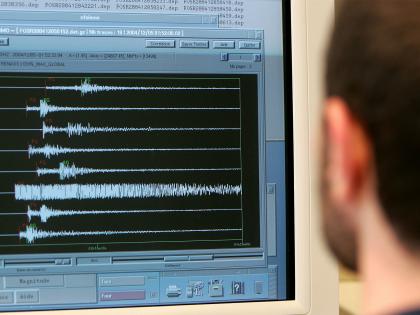
Earthquake of magnitude 4.1 strikes Tibet
New Delhi [India], May 8 : An earthquake of magnitude 4.1 struck Tibet in the early hours of Friday, according to the National Centre for Seismology (NCS).
The tremor occurred at 3:10 am IST on May 8 at a depth of 38 kilometres.
As per the NCS, the earthquake was recorded at a latitude of 35.385 North and a longitude of 85.112 East in Tibet.
"EQ of M: 4.1, On: 08/05/2026 03:10:17 IST, Lat: 35.385 N, Long: 85.112 E, Depth: 38 Km, Location: Tibet," NCS posted on X.
{{{{twitter_post_id####}}}}EQ of M: 4.1, On: 08/05/2026 03:10:17 IST, Lat: 35.385 N, Long: 85.112 E, Depth: 38 Km, Location: Tibet.
For more information Download the BhooKamp App https://t.co/5gCOtjdtw0 @DrJitendraSingh @OfficeOfDrJS @Ravi_MoES @GSuresh_NCS @ndmaindia pic.twitter.com/R4yefAY6LW
— National Center for Seismology (@NCS_Earthquake) May 7, 2026
Shallow earthquakes are generally more dangerous than deep earthquakes. This is because the seismic waves from shallow earthquakes travel shorter distances to the surface, resulting in stronger ground shaking, greater structural damage, and higher casualties.
The Tibetan Plateau is characterised by seismic activity due to tectonic plate collisions.
Tibet and Nepal lie along a major geological fault line where the Indian tectonic plate converges with the Eurasian plate, resulting in frequent earthquakes. The region is seismically active due to tectonic uplift that can become sufficiently strong to alter the elevations of the Himalayan peaks.
The Tibetan Plateau attains its high elevation due to crustal thickening caused by the collision of the Indian and Eurasian plates, which created the Himalayas. Faulting within the plateau is associated with strike-slip and normal mechanisms. The plateau extends east-west, as evidenced by north-south-striking grabens, strike-slip faulting, and GPS data.
In the northern region, strike-slip faulting is the dominant tectonic style, while in the south, the dominant tectonic domain is east-west extension on north-south-trending normal faults.
The largest earthquakes in Tibet, with magnitudes of 8.0 or similar, occur along strike-slip faults. Normal-faulting earthquakes are smaller in magnitude; in 2008, five normal-faulting earthquakes with magnitudes of 5.9 to 7.1 occurred across the plateau.
Disclaimer: This post has been auto-published from an agency feed without any modifications to the text and has not been reviewed by an editor
Open in app