
India-Israel ties set to grow stronger with deeper social engagement: Report
By IANS | Updated: April 11, 2026 15:20 IST2026-04-11T15:18:09+5:302026-04-11T15:20:24+5:30



Tel Aviv/New Delhi, April 11 India and Israel must broaden their social base to build a more resilient, ...
India-Israel ties set to grow stronger with deeper social engagement: Report
Tel Aviv/New Delhi, April 11 India and Israel must broaden their social base to build a more resilient, normalised, and forward-looking partnership.
This calls for serious investment in mid-level and everyday engagement among students, professionals, workers, artists, researchers, tourists, and local communities — the social bedrock of a long-term strategic relationship, a report has highlighted.
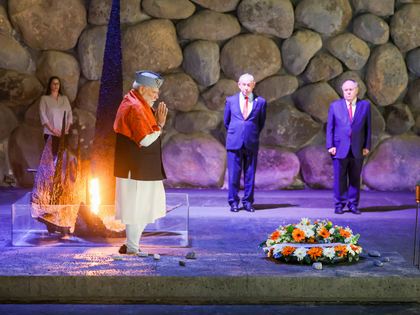
“For years, India-Israel relations have been defined by the language of strategy: defence, agriculture, intelligence, technology, and trade. That is not wrong. The partnership is real, deep, and increasingly visible. Prime Minister Narendra Modi’s February 2026 visit to Israel only reinforced what many already understood: The relationship has moved from the margins to the strategic mainstream,” a report in 'The Jerusalem Post' detailed.
The report stressed that for the next phase of India–Israel relations to be sustainable, it must extend beyond government-level ties.
“This matters because strategic partnerships are strongest when they are not confined to elite circles. Official visits, security cooperation, and economic agreements can build momentum, but they do not by themselves create familiarity, trust, or long-term public legitimacy. Those are built elsewhere: in classrooms, workplaces, neighbourhoods, cultural exchanges, and the small, human interactions that make one society more intelligible to another,” it mentioned.
According to the report, many Indians continue to view Israel largely through the lens of geopolitics and conflict, while many Israelis admire India often in broad civilisational or touristic terms rather than through “sustained human engagement”.
“In both cases, the gap between strategic familiarity and social familiarity remains wider than it should be. That gap matters. Public perceptions shape the political environment in which strategic partnerships operate. They influence how societies interpret crisis, how they react to controversy, and whether bilateral ties are seen as transactional or meaningful,” it emphasised.
“This is why everyday encounters matter. A cultural workshop, a student exchange, a shared festival, or a workplace friendship may seem minor compared to defence agreements or state visits. Yet these interactions do something official diplomacy often cannot: They humanise the other side,” it further stated.
The report highlighted that although India-Israel ties have deepened considerably over the past decade, their growing maturity brings a new challenge: how to sustain the partnership beyond leaders, crises, and strategic compulsions.
The answer, it said, lies not just in military cooperation or political symbolism, but also in the steady cultivation of social ties.
“The future of India-Israel relations will be shaped not only in defence corridors and diplomatic meetings, but also in kitchens, campuses, workplaces, and digital spaces. That is where familiarity grows, where trust becomes more durable, and where strategic partnership acquires human depth,” it concluded.
Disclaimer: This post has been auto-published from an agency feed without any modifications to the text and has not been reviewed by an editor
Open in app