
"Middle East, Persian Gulf "a crisis knot that will be very difficult to untie," says Russian FM Lavrov
By ANI | Updated: April 15, 2026 10:45 IST2026-04-15T16:14:53+5:302026-04-15T10:45:14+5:30



Beijing [China], April 15 : Even as the world watches a tenous ceaefire between Iran and the US playout ...
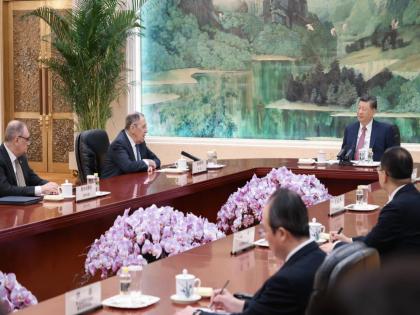
"Middle East, Persian Gulf "a crisis knot that will be very difficult to untie," says Russian FM Lavrov
Beijing [China], April 15 : Even as the world watches a tenous ceaefire between Iran and the US playout a key meeting was held on Wednesday in Beijning between Russia's Foreign Minister Sergey Lavrov and Chinese President Xi Jinping. Speaking after the meeting Lavrov said that China and Russia will not be pushed into the background, and will remain active in the Middle East situation.
Lavrov further said that the crisis in the Gulf region will not return to normalcy with the effort to cut it off.
"The Middle East and the Persian Gulf region, where the most significant events are taking place, represent an obvious crisis... a crisis knot that will be very difficult to untie, and attempts to simply cut it, I think, are unlikely to produce results. Palestine, Gaza, and the West Bank must not remain in the shadows or be pushed into the background. We clearly reaffirmed this today with the Chinese delegation," he said.
Lavrov added that the West's attempts to assert its hegemony through modern form of colonialism, living at the expense of others.
"In the international sphere, we are interested in blatant attempts by the West, both the United States and Europe, to maintain and even upgrade its hegemony, based on the assumption that 500 years of experience in conquering the world and subordinating it to their own interests, and creating mechanisms of global governance that allow them to live at the expense of others, including the slave trade, colonialism, and much more, can somehow be modernized and continued using modern methods, as I said, living at the expense of others and subordinating them to their will. Neither China nor the Russian Federation, like the vast majority of countries in the world, can agree with this approach," he said.
Lavrov, while delivering remarks to the media, said that hotbeds of tension are emerging in Europe.
"We also reviewed the situation in various regions, paying special attention to Eurasia, where more and more hotbeds of tension are emerging in Europe. This activity of NATO is linked to the search for a new meaning of its existence, primarily through drawing Ukraine into its ranks. It is also the militarization of the European Union, which we are witnessing against the backdrop of crisis phenomena within NATO, due to disagreements between Washington and European capitals, primarily the Brussels bureaucracy," he said.
Lavrov further said that in Central Asia, there are attempts to set external rules.
"In Central Asia, an important process is unfolding, where attempts are being made to set external rules and play a leading role in shaping how Central Asian states organize their lives and with whom they build relations. Similar trends, though less visible, are emerging in the South Caucasus, not to mention long-standing crises resulting from Western policies that have accumulated over many years in Southeast Asia, Northeast Asia, including the Korean Peninsula, the Taiwan Strait, and the South and East China Seas. In other words, the entire Eurasian continent is becoming an arena of serious, opposing trends and practical actions by leading members of the international community," he said.
Lavrov's meeting with Xi follows his meeting with Chinese Foreign Minister Wang Yi. The Russian Foreign minister was categorical in his criticism of the west for aggravating the situation.
"For obvious reasons, international issues, especially since the international situation, which is now being aggravated by the actions of our Western colleagues, in Ukraine, in Latin America, in the Strait of Hormuz, and in other parts of our shared Eurasian continent with China, is having a direct impact on how bilateral relations between states are developing, including, of course, between Russia and China, and with other partners within the Shanghai Cooperation Organization and BRICS, among others," he said.
During the same meeting, Lavrov said that relations between Russia and China serve as a stabilizer in global affairs and are growing in importance for the global majority,
Disclaimer: This post has been auto-published from an agency feed without any modifications to the text and has not been reviewed by an editor
Open in app