
UAE's OPEC exit "fully aligned" with US, on course to peaceful agreement with Israel: Economist John Sfakianakis
By ANI | Updated: April 30, 2026 20:35 IST2026-05-01T02:01:29+5:302026-04-30T20:35:08+5:30



Riyadh [Saudi Arabia], April 30 : Chief Economist and Head of Economic Research at the Gulf Research Centre, John ...
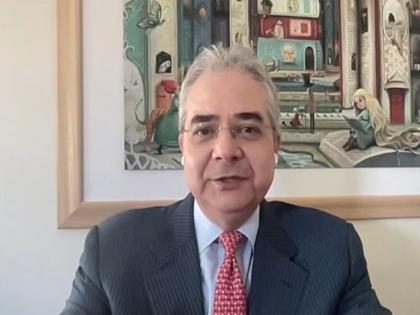
UAE's OPEC exit "fully aligned" with US, on course to peaceful agreement with Israel: Economist John Sfakianakis
Riyadh [Saudi Arabia], April 30 : Chief Economist and Head of Economic Research at the Gulf Research Centre, John Sfakianakis, on Thursday said that the United Arab Emirates' recent exit from the Organisation of the Petroleum Exporting Countries (OPEC) and OPEC+ is "fully aligned" with the United States' energy and geopolitical strategy and signals a broader realignment in Gulf politics.
Speaking to ANI, on the UAE's announcement of its exit from OPEC and the broader OPEC+ grouping, Sfakianakis said that the move places Abu Dhabi on a trajectory closely aligned with Washington, particularly on energy policy and regional diplomatic priorities.
He added that this alignment also extends to US-backed regional diplomacy, including efforts encouraging Gulf states to normalise relations with Israel.
"I think that it places the UAE on a course to be fully aligned with the US. Also, it's on a course to be fully aligned with what the US would like many Gulf states, including Saudi Arabia, to be in a peaceful agreement with Israel," he said.
He pointed to the UAE's participation in the Abraham Accords as a key factor shaping its strategic orientation, noting that Washington views such steps positively and suggested that the development reinforces convergence between Abu Dhabi and Washington on Middle East policy.
"The UAE has signed the Abraham Accords. So that is something that President Trump favours, and he sees this as positive and aligned with what the UAE has done. Saudi Arabia, on the other hand, has not signed the Abraham Accords, and so in his mind, that is an issue. And definitely that deepens the rift between Saudi Arabia and the UAE," Sfakianakis added.
The Economist also highlighted growing divergence within the Gulf Cooperation Council (GCC), particularly between the UAE and Saudi Arabia, over long-term energy strategy.
He said Saudi Arabia and the US broadly continue to see a sustained future for hydrocarbons, while the UAE is increasingly positioning itself for a post-oil economy, focusing on diversification and expanding production in the near term, adding that Abu Dhabi is motivated to maximise output before transitioning away from hydrocarbons.
"What is interesting is that the UAE does not necessarily share the view that oil will be important in the decades to come. And so their motivation is to exit OPEC, which is containing their supply potential, and to pump more oil. And this is what they will be doing in the coming years. They will be pumping more oil, that is, the UAE, against what Saudi Arabia wants to do. And the UAE believes that there is a kind of post-oil future, which they need to double down on and diversify, and they need to sell more of what they have in the ground in order to diversify away from hydrocarbons and oil, that is," he stated.
The expert further suggested that differing economic and geopolitical approaches could deepen existing tensions between Abu Dhabi and Riyadh, which have already diverged on regional issues including Yemen, Syria, Sudan, and Lebanon.
He described the relationship as increasingly competitive, with both countries pursuing distinct visions for oil policy and regional influence.
"I definitely believe that this basically has created a huge rift, a political rift, between Saudi Arabia and the UAE. But it has been a rift for quite some time. It's nothing unique. They had differences on regional foreign policy issues and on the management of crises. The example, of course, that comes to mind is Yemen, Sudan, differences about Syria and Lebanon, and so forth. But also more existential issues about how to form oil policy, and also how to portray that oil policy through either containment or by extracting more and producing more. I think the rift will continue, and definitely we will see it reverberate either by an exit of the UAE from the Arab League, from the GCC Secretariat, and so forth," Sfakianakis stated.
While acknowledging Saudi Arabia's continued dominance in global oil production capacity, Sfakianakis said Riyadh remains a "reliable and central supplier" to global energy markets, providing stability amid shifting regional dynamics.
Earlier on Wednesday, US President Donald Trump welcomed the UAE's decision to exit the OPEC and OPEC+ alliance, saying the move could help bring down global oil and gas prices.
"That's a good thing for getting the price of gas down, getting oil down, getting everything down. They have it all. He's a great leader, actually. I'm okay. They're having some problems in OPEC," Trump said, referring to UAE President Sheikh Mohammed bin Zayed Al Nahyan.
On Tuesday, the UAE announced its exit from OPEC and the broader OPEC+ grouping, marking a significant shift in global oil dynamics. The country, OPEC's third-largest producer, has increasingly pushed for greater production flexibility amid the West Asia crisis and supply disruptions.
Disclaimer: This post has been auto-published from an agency feed without any modifications to the text and has not been reviewed by an editor
Open in app