
Ajit Pawar’s Plane Attempted Second Landing in Baramati; Pilot Gave ‘Mayday’ Call After Spotting Glitch
By Lokmat Times Desk | Updated: January 28, 2026 14:03 IST2026-01-28T14:02:56+5:302026-01-28T14:03:03+5:30



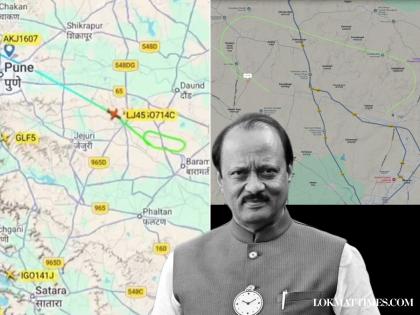
Details from the flight tracker and radar shared on social media show how the tragic plane crash that claimed ...
Ajit Pawar’s Plane Attempted Second Landing in Baramati; Pilot Gave ‘Mayday’ Call After Spotting Glitch
Details from the flight tracker and radar shared on social media show how the tragic plane crash that claimed the life of Maharashtra Deputy Chief Minister Ajit Pawar and four others on Wednesday morning, January 26. Preliminary learning from flight radar satellite applications shared by X user suggests that extreme weather conditions and the technical glitches during landing at the Baramati airstrip played a significant role in the plane crash.
Indian media reporting the crash of a business jet this morning has claimed the life of Maharashtra Deputy Chief Minister Ajit Pawar and 4 others. The aircraft was attempting a second approach to Baramati Airport when it crashed. https://t.co/0RKiD9sZVUpic.twitter.com/1kcoWgc3I1
— Flightradar24 (@flightradar24) January 28, 2026
The twin-engine Learjet 45, operated by Delhi-based VSR Ventures, was attempting to land at Baramati Airport at approximately 8:45 am amidst thick fog. Visibility across the Pune-Baramati region was reported to be dangerously low at the time of the incident. According to the Flightradar24 map, the aircraft was attempting a second approach when it crashed, which means at the first attempt, the aircraft was failed to land and tried it for the second time after taking a U-turn in the air before crashing and bursting into flames.
According to the data shared by a senior journalist, Rahul Shivshankar, the Baramati airstrip is a regional facility; it lacks an Instrument Landing System (ILS), which usually provides automated guidance to pilots during poor visibility. Consequently, the flight crew was forced to conduct a manual and visual approach. Flight data indicates that the pilot aborted the first landing attempt after failing to align with the runway, executing a wide turn to begin a second approach.
Crash Sequence:
— Rahul Shivshankar (@RShivshankar) January 28, 2026
•Dense fog over the Pune–Baramati area, visibility extremely low.
•Baramati airstrip is small and does not have ILS (Instrument Landing System) facilities.
•The pilot had to attempt a manual and visual landing.
•The aircraft did not approach the runway… pic.twitter.com/J7CYX4vXIn
During the second attempt, the pilot issued a "MAYDAY" distress call, signalling an emergency on board after spotting a technical glitch in the aircraft during the second landing attempt after it failed the first. It is learned that the aircraft struggled to maintain balance at an altitude of approximately 100 feet.
Baramati features a "table-top" runway, where the landing strip is located on a plateau with steep drops at the ends. The aircraft reportedly fell short of the runway threshold, striking the ground near the edge. The impact triggered an immediate and massive explosion, followed by a series of smaller blasts as the fuel tanks ignited, resulting in a massive fire destroying the aircraft within minutes before firefighters reached the spot.
Also Read | Who Was Vidip Jadhav? PSO Dies Alongside Ajit Pawar in Baramati Plane Crash.
The Maharashtra government has declared three days of state mourning. Prime Minister Narendra Modi and Chief Minister Devendra Fadnavis lead the nation in mourning the loss of the 66-year-old leader, who was en route to a campaign rally for the Zilla Parishad elections.
A high-level team from the Aircraft Accident Investigation Bureau (AAIB) has arrived at the site to recover the Flight Data Recorder (FDR) and Cockpit Voice Recorder (CVR). The investigation will examine whether mechanical failure contributed to the loss of control or if the combination of low visibility and the challenging tabletop terrain proved insurmountable for a manual landing.
Open in app