
AI cannot replace humans: Arjun Ram Meghwal at book launch
By IANS | Updated: April 30, 2026 18:05 IST2026-04-30T17:58:17+5:302026-04-30T18:05:14+5:30



New Delhi, April 30 “Innovation, Technology or Artificial Intelligence cannot replace a human being. AI poses many challenges, ...
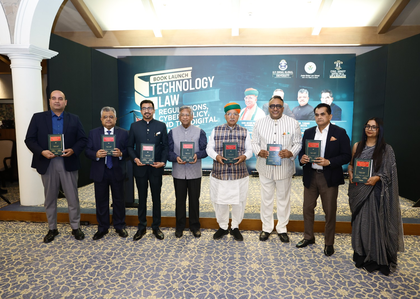
AI cannot replace humans: Arjun Ram Meghwal at book launch
New Delhi, April 30 “Innovation, Technology or Artificial Intelligence cannot replace a human being. AI poses many challenges, and we have become exceedingly technologically advanced, but it cannot replace a person,” said Arjun Ram Meghwal, Hon’ble Minister of State for Law & Justice (IC), Government of India at the Launch of the book, Technology Law: Regulations, Cyber Policy, and the Digital Landscape authored by Rodney D. Ryder & Nikhil Naren.
“People have been suspicious of new developments since the time of the steam engine. It led to a change with new developments and an increase in commerce. We adapt to changes in the world as technology keeps advancing. Similarly, we are now in the age of AI and robotics, but it will lead to new opportunities, too. What will change is the facet of jobs and opportunities, and experts need to harness and develop them. Technological intervention is also increasing in the legal field. We are now in the era of Industry 4.0. We have to accept these new challenges and understand how they can benefit the nation. The book Technology Law: Regulations, Cyber Policy, and the Digital Landscape will help us to understand how best to utilise emerging technological opportunities,” the Hon’ble Minister said.
The book - Technology Law: Regulations, Cyber Policy, and the Digital Landscape by Rodney D. Ryder & Nikhil Naren helps one understand their rights, risks and how to navigate the intersection of law and technology with confidence.
Packed with sharp policy and legal insights typically scattered across multiple specialist texts, it offers the finest clarity at a student-friendly price, making it one of the most comprehensive yet affordable companions to technology law available. It covers the entire spectrum of technology law – from the Indian Information Technology Act [and Rules], Data Protection, Surveillance, Online Brand Management, to New technologies.
The book will be a welcome addition to the libraries of professionals and an essential part of the University curriculum.
In his Welcome Address, Prof. (Dr.) C. Raj Kumar, Founding Vice Chancellor of O.P. Jindal Global University, said, “I congratulate Professor Nikhil Naren and co-author Mr Rodney Ryder, both of whom have made a significant contribution to the area of technology law. At a time when there is so much discourse surrounding the role of AI and its impact on the future, it is this kind of academic work that will give us clarity, coherence, and greater understanding and appreciation of the realm of ideas in which AI will impact the future of law and justice. A knowledge society connected with innovation and technology, and the role of law and justice, which strengthens our democratic institutions, is the only way by which we will achieve our vision of being a Viksit Bharat.”
The Guests of Honour were Mr R. Venkataramani, Attorney General for India, Mr Tushar Mehta, Solicitor General of India and Mr Amitabh Kant, Former G20 Sherpa, Government of India.
“Books have been written about how, in a technology and science-driven world tomorrow, life will look like. Sometimes it's scary, sometimes it looks really wonderful. But then we do not know how we will navigate it. Our minds cannot be subjected to any regulation except freedom of speech and expression. It's important for us to keep what's called the impact of our mind; and our minds will always remain as free as possible to be able to define the fundamentals of law, the contours of law, the application of law and the impact of law. I think the question is to deal with the impact of impacts. No part of life is free from regulation and law.” R. Venkataramani, Attorney General for India, said.
“India is progressing in leaps and bounds, and in digital India, we are ahead of our time. When I talk about digital law, I mean the intersection between India and the international legal regime. As far as the digital medium is concerned, the world is one unit. There are no country barriers. There are no physical barriers. Now the difficulty is that when I do something, I do so in the context of the limitations placed upon me by my Constitution, which defines my freedoms and also stipulates the limitations on my freedom. The similar freedom or the similar limitations are not to be found in other countries. The second challenging aspect is artificial intelligence. Artificial intelligence, to my mind, so far has remained statutorily unregulated. I do not see any comprehensive legislative framework that regulates, controls, or defines artificial intelligence. Artificial intelligence has thrown several challenges at us that we as the human race have never imagined. Therefore, we need professionals who understand the technological aspects of the digital medium as well as its legal aspects, and who can develop a holistic regime that applies globally. If we build technology as digital public infrastructure, keep it interoperable, open, and secure, we can do population-scale transformation,” Tushar Mehta, Solicitor General of India, said.
Amitabh Kant, Former G20 Sherpa, Government of India, said, “This book is remarkable in many ways, firstly because I've always believed that India's digital transformation is one of the most significant development stories in the world today. We have 1.5 billion digital identities, but between 2015 and 2017, we opened 550 million bank accounts; every second, a bank account was opened in India. We then linked them up with Aadhaar and mobile numbers. This enabled fast payments, and then a number of start-ups began offering credit, stock markets, tax services to cities, and insurance to rural areas. Courts should be the place for matters that genuinely require adjudication, not the first destination for every routine dispute. Court technology must not be seen as a back-office computerisation exercise. It should function as a complete operating system which is spread across alternative dispute resolution.”
Rodney D. Ryder, Founding & Senior Partner of Scriboard and co-author of the book, said, “It's a historical record of the things we as a nation have been able to accomplish with technology law. The development of the Information Technology Act has been a wonderful example of a continuous quarter-century of policy work by successive governments, carried out with speed and clarity. This book is a distillation and also meant to be a resource for academia.”
Prof. Nikhil Naren, Chevening Scholar, Assistant Director, Cyril Shroff Centre for AI, Law and Regulation and Assistant Professor, Jindal Global Law School and co-author of the book, said, “We cannot be apolitical at any given point of time. Policy and politics always reach us, so has technology. So, when it comes to writing something on technology and policy, it's obviously a very demanding task owing to its dynamic nature. I strongly believe that the law must be imaginative enough to enable innovation but rigorous enough to protect rights, dignity and democratic institutions.”
Prof. Naren highlighted a few new ideas he thought should be included in the text, such as introducing the concept of “social media paranoia,” a condition in which visibility, validation, trolling, virality, and constant comparison reshape how individuals think, behave, and seek approval online.
The book with reasons argues that the vocabulary of the digital age must also evolve: the term “influencer” overstates social authority and masks the attention economy beneath it, while “clickstar” more accurately captures internet personalities whose prominence is built on clicks, reach, engagement, and algorithmic visibility rather than genuine influence.
Prof. (Dr.) Dipika Jain, Executive Dean of Jindal Global Law School, introduced the Jindal Global Law School. A Critical Appreciation was given by Prof. (Dr.) S.G. Sreejith Dean, Strategy & Institution Building, Office of the Vice Chancellor, O.P. Jindal Global University and the Vote of Thanks was given by Prof. Paavni Jain, Assistant Director, Cyril Shroff Centre for AI, Law & Regulation.
--IANS
scor/dan
Disclaimer: This post has been auto-published from an agency feed without any modifications to the text and has not been reviewed by an editor
Open in app