
Kerala Polls: UDF ends Left era, signals fall of CPI(M)’s last bastion (Round Up)
By IANS | Updated: May 4, 2026 19:20 IST2026-05-04T19:17:16+5:302026-05-04T19:20:10+5:30



Thiruvananthapuram, May 4 Kerala’s 2026 Assembly poll verdict marks not just a change of government but the end ...
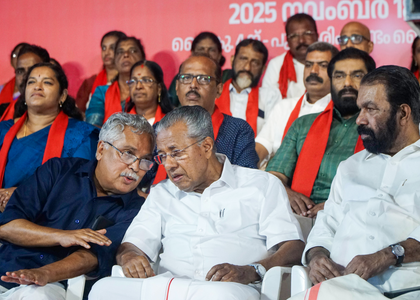
Kerala Polls: UDF ends Left era, signals fall of CPI(M)’s last bastion (Round Up)
Thiruvananthapuram, May 4 Kerala’s 2026 Assembly poll verdict marks not just a change of government but the end of an era in Indian politics, with the Congress-led United Democratic Front (UDF) dismantling the decade-long rule of the Left Democratic Front (LDF) led by Chief Minister Pinarayi Vijayan.
More significantly, the result leaves India without a single Left-led state government for the first time in more than five decades.
Even as the final tally has not been declared by the Election Commission, the UDF has touched 102, the Left 35 and the BJP 3 seats.
With earlier losses in West Bengal and Tripura, Kerala had remained the last major bastion of the CPI(M)-led Left.
The latest verdict, therefore, carries national implications, marking a structural decline of Left electoral dominance in India’s federal landscape.
The scale of the setback is stark. Of the 21 member Cabinet, 13 ministers were defeated, reflecting deep voter dissatisfaction with the Kerala government.
Even Pinarayi Vijayan, who retained his seat, saw his winning margin shrink dramatically and trailed in the early rounds, an unusual development in what was once considered a secure constituency.
The UDF’s resurgence, steered by V.D. Satheesan, was built on a carefully-calibrated campaign that combined governance critique with a promise of administrative reset.
The Congress recorded its highest-ever tally (63) in the state, while the alliance successfully consolidated women, youth, and sections of traditional Left voters.
Leaders such as Rahul Gandhi and Priyanka Gandhi Vadra added momentum, but the outcome was largely shaped by booth level mobilisation and localised strategies.
Equally telling was the erosion of the Left’s traditional strongholds.
Regions like Kannur, long considered ideological citadels, witnessed unexpected reverses.
The victories of former CPI(M) heavyweights such as G. Sudhakaran, T.K. Govindan and V. Kunjikrishnan outside the party fold underscored internal fractures within the Left’s core base.
Adding a new dimension, the BJP registered its best-ever performance in Kerala, winning three seats.
Victories by Rajeev Chandrasekhar, B.B. Gopakumar, and V. Muraleedharan signal a gradual expansion in urban pockets, suggesting a slow shift from a strictly bipolar contest.
The 2026 verdict reflects a maturing electorate willing to recalibrate loyalties based on governance and credibility rather than ideological continuity.
For the UDF, the mandate brings both opportunity and pressure to deliver on promises of change.
For the Left, the loss of its last stronghold signals the need for deep introspection and reinvention.
In sum, Kerala has not just changed its government, it has redrawn the contours of national politics, marking the end of the Left’s uninterrupted state-level presence in India.
Disclaimer: This post has been auto-published from an agency feed without any modifications to the text and has not been reviewed by an editor
Open in app