
'Not a Grihasthi, yet I understand it all': PM Modi hails women’s empowerment through govt’s schemes
By IANS | Updated: April 13, 2026 14:20 IST2026-04-13T14:18:24+5:302026-04-13T14:20:08+5:30



New Delhi, April 13 Prime Minister Narendra Modi said on Monday that although he may not be a ...
'Not a Grihasthi, yet I understand it all': PM Modi hails women’s empowerment through govt’s schemes
New Delhi, April 13 Prime Minister Narendra Modi said on Monday that although he may not be a Grihasthi (householder), he understands domestic life, and that through various government schemes, women are becoming economically empowered.
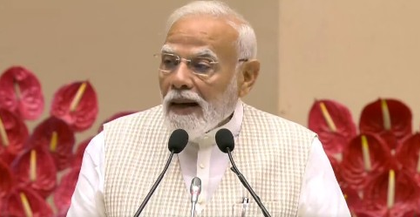
Addressing the Nari Shakti Vandan Sammelan at Vigyan Bhawan, the Prime Minister said the path to reaching Parliament is set to become easier for women, and their role has become even more crucial.
“Parliament is on the verge of creating new history, one that will realise the visions of the past and fulfil the resolutions of the future,” he said.
He emphasised that it was the government's effort and priority to ensure the amendment bill to Nari Shakti Vandan Adhiniyam is passed through dialogue, cooperation and participation of all.
When the Nari Shakti Vandan Adhiniyam was introduced in 2023, it was passed unanimously by all parties in Parliament, he noted.
Prime Minister Modi hailed Panchayati Raj institutions as a remarkable example of women's leadership and said India's Nari Shakti has made immense contributions to nation-building.
The success of the Jal Jeevan Mission stands as a prime example of how women have played a significant role at the Panchayat level. Studies have shown that increased participation of women in decision-making leads to greater sensitivity and responsiveness within systems, he added.
He listed several flagship schemes that have benefited women, including Beti Bachao Beti Padhao, the Maternity Benefit Scheme, Sukanya Samriddhi Yojana for post-birth support, and Mission Indradhanush to ensure timely vaccinations for children.
The PM said that to address the lack of toilets in schools, the government launched the Swachh Bharat Abhiyan. It provides free sanitary pads, offers annual financial assistance of Rs one lakh for sports, and has opened Sainik Schools for girls aspiring to join the armed forces. For later stages of life, the Ujjwala Yojana protects women from the hazards of kitchen smoke, Har Ghar Nal (every house with tap water) ensures access to clean tap water at home, and Ayushman Yojana provides free medical treatment up to Rs five lakh.
"Our sisters and daughters are reaping the greatest benefits from all these initiatives," he said. More than 30 million women have become homeowners under government housing schemes.
"Typically, when fathers and sons discuss business, if the mother enters the room, they would often say, 'You go away'. Now that those women have become economically empowered, even the sons say do call mother over.
“I may not be a householder myself, but I understand everything about domestic life,” the Prime Minister observed with a smile. He extended his congratulations to all the women of India on the dawn of a new era.
"For decades, everyone has felt the need to provide reservations for women within our democratic framework. Nearly 40 years have passed since discussions began regarding the Women's Reservation Bill. This journey involves the efforts of all political parties and multiple generations. Every party has advanced this concept in its own distinct manner. When the Act was passed in 2023, all political parties unanimously voted in its favour. There was also a resounding consensus that, come what may, it must be implemented by 2029. The women of the country should meet with their Members of Parliament, present their perspectives, and articulate their expectations," he said.
"On the day the MPs leave to attend the parliamentary session, bid them farewell with garlands of flowers. For when the MPs depart carrying the blessings of our mothers and sisters, they will be left with no choice but to make the right decision," said Prime Minister Modi.
A special three-day session of Parliament is being convened from April 16 to 18 with the objective of introducing amendments to implement women's reservation. The original Nari Shakti Vandan Adhiniyam had linked the reservation to the new census and the subsequent delimitation exercise. Due to the delay in conducting the fresh census, the government now plans to proceed based on the 2011 census data.
Following the amendment, the number of Lok Sabha seats could potentially increase from 543 to 816, with provisions to reserve one-third of the seats for women while maintaining the existing structure for SC and ST reservations. No separate provision for OBC reservation within the women's quota has been made at this stage.
The government has planned two major amendments, including a separate Delimitation Bill. Both are expected to be taken up as constitutional amendments during the upcoming session.
Prime Minister Modi has called upon all political parties to support this historic step in the spirit of consensus that marked the original passage of the Act in 2023, so that Nari Shakti can play a fuller role in shaping the future of a developed India.
Disclaimer: This post has been auto-published from an agency feed without any modifications to the text and has not been reviewed by an editor
Open in app