
Number of train accidents in India is down from 135 in 2014-15 to 31 in 2024-25: Railway Minister
By IANS | Updated: December 10, 2025 15:40 IST2025-12-10T15:35:21+5:302025-12-10T15:40:10+5:30


New Delhi, Dec 10 There has been a steep decline in accidents on Indian Railways, with the number ...
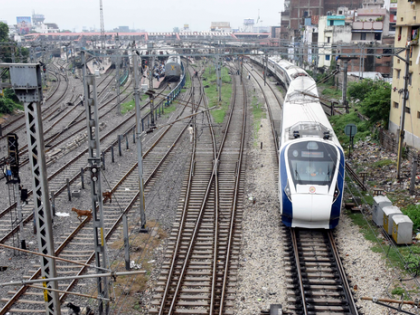
Number of train accidents in India is down from 135 in 2014-15 to 31 in 2024-25: Railway Minister
New Delhi, Dec 10 There has been a steep decline in accidents on Indian Railways, with the number of "consequential train accidents" coming down from 135 in 2013-14 to 31 in 2024-25 and further to 10 in 2025-16 till November this year, Railways Minister Ashwini Vaishnaw informed Parliament on Wednesday.
The minister highlighted that the number of consequential train accidents during the period 2004-14 was 1711 (average 171 per annum), which has declined to 31 in 2024-25 and further to 10 in 2025-26 (up to November 2025).
In a written reply to a question in the Lok Sabha, he further stated that another important index showing improved safety in train operations is Accidents Per Million Train Kilometre (APMTKM), which has reduced from 0.11 in 2014-15 to 0.03 in 2024-25, indicating an improvement of approximately 73 per cent during this period.
Vaishnaw highlighted various safety measures taken by the Indian Railways to enhance safety in train operations. He said that the budgetary outlay for safety-related activities had been enhanced nearly 3-fold from Rs 39,463 crore in 2014-15 to over Rs 1.16 lakh crore in 2025-26 in order to reduce the risk of accidents on the rail network.
Electrical and electronic Interlocking Systems with centralised operation of points and signals have been provided at 6,656 stations up to October 31, 2025, to reduce the risk of accidents that occur due to human failure. Besides, interlocking of level crossing (LC) gates has been provided at 10,098 Level Crossing Gates up to October 31 this year for enhancing safety at LC gates. Complete Track Circuiting of stations to enhance safety by verification of track occupancy by electrical means has also been provided at 6,661 stations up to October-end, the minister said.
The minister further highlighted that the high-tech Kavach safety system was adopted in July 2020 to bring down the occurrence of accidents. The latest Kavach version has been successfully commissioned on the Palwal-Mathura-KotaNagda section (633 Rkm) on the Delhi-Mumbai route, and on the Howrah-Bardhaman section (105 RKm) on the Delhi-Howrah route. Kavach implementation has been taken up in the balance sections of the Delhi-Mumbai and Delhi-Howrah routes. Further, Kavach implementation has been taken up on 15,512 RKm covering all GQ, GD, HDN and identified sections of Indian Railways.
All locomotives are equipped with Vigilance Control Devices (VCD) to improve the alertness of Loco Pilots. Retro-reflective sigma boards are provided on the mast, which is located two OHE masts prior to the signals in electrified territories, to alert the crew about the signal ahead when visibility is low due to foggy weather in order to prevent accidents. A GPS-based Fog Safety Device (FSD) is also provided to loco pilots in fog-affected areas, which enables loco pilots to know the distance of the approaching landmarks such as signals and level crossing gates, the minister said.
Modern track structure consisting of high tensile strength rails, prestressed concrete sleepers with elastic fastening, is being used while carrying out primary track renewals. Mechanisation of track-laying activity through the use of track machines has helped to reduce human errors.
Indian Railways is also maximising the supply of 130m/260m long rail panels for increasing the progress of rail renewal and avoiding welding of joints, thereby improving safety.
Ultrasonic Flaw Detection testing of rails to detect flaws and timely removal of defective rails, laying of longer rails, minimising the use of Alumino Thermic Welding, and adoption of better welding technology for rails is also ensuring greater safety, the minister pointed out.
Monitoring of track geometry, patrolling of railway tracks to look out for weld/rail fractures and inspections at regular intervals are carried out to monitor and educate staff for observance of safe practices. Web-based online monitoring system of track assets, viz. Track database and decision support system, have been adopted to decide rationalised maintenance requirements and optimise inputs are other steps that have been taken to prevent accidents, the minister added.
Disclaimer: This post has been auto-published from an agency feed without any modifications to the text and has not been reviewed by an editor
Open in app