
8th Pay Commission: Central Govt Employees and Pensioners To Go on Nationwide Protest on April 16 Over DA Hike Delay
By Lokmat Times Desk | Updated: April 16, 2026 11:32 IST2026-04-16T11:31:15+5:302026-04-16T11:32:22+5:30



Central government employees and pensioners are scheduled to hold a nationwide protest on Friday, April 16, over the delay ...
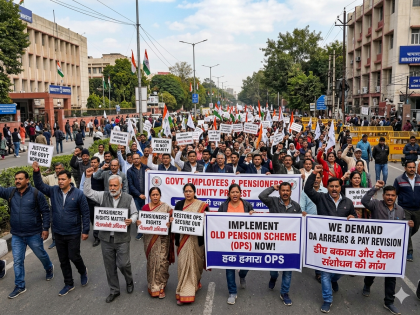
(Photo Credit: AI | Representational Image)
Central government employees and pensioners are scheduled to hold a nationwide protest on Friday, April 16, over the delay in the Dearness Allowance (DA) hike, which is usually given every six months. Unions will observe a lunch hour protest at workplaces across the country, said the Confederation of Central Government Employees & Workers (CCGEW).
The CCGEW wrote to Finance Minister Nirmala Sitharaman, expressing concern over the delay in announcing the DA hike. The organisation states that the Narendra Modi government had last revised DA in October 2025, effective from July 2025 and employees have been waiting since January 2026.
"This is to give notice that the employees who are members of the affiliated organisations of the Confederation of Central Government Employees and Workers will hold a lunch hour's demonstration at all workplaces on April 16, 2026, and send a resolution," the notice read.
They demand that the government announce the pending DA and DR hike effect from January 1, 2026, for both central government employees and pensioners. Because the DA revision is pending, pensioners are also not getting the Dearness Relief (DR), which is linked to DA.
"The single demand pursuant of which the employees will embark upon the above action programme is 'immediate declaration of the due instalment of DA/DR, w.e.f., January 1, 2026, for employees and pensioners," the letter further reads.
8th Pay Commission Proposal: Key Changes Suggested for Salaries, Pensions and Allowances
Unions have submitted proposals for the 8th Pay Commission, suggesting major changes in salaries, pensions and allowances. The draft committee of the National Council (JCM) has presented its recommendations to the government, outlining several reforms that could be implemented from 2026.
One of the key demands is to increase the minimum basic salary from Rs 18,000 to Rs 69,000. For this, a fitment factor of 3.83 has been proposed. If approved, it would result in a substantial rise in salaries and pensions. The proposal also seeks implementation of the revised pay structure from January 1, 2026.
To ensure that employee incomes keep pace with inflation, the draft recommends an annual pay hike of 6%, higher than the current rate. It also proposes simplifying the existing pay matrix by reducing the 18 levels under the 7th Pay Commission to seven levels. This, it says, would streamline promotions and prevent employees from remaining stuck at one level for long periods.
Another major demand is the reintroduction of the Old Pension Scheme (OPS) for employees who joined service after 2004. The proposal also calls for increasing pensions to 67% of the last drawn salary and family pensions to 50%. In addition, it suggests that every employee should receive at least five promotions or career upgrades over a 30-year service period.
The draft further recommends increasing house rent allowance, which could go up to 30% or more in metro cities. It also calls for enhanced insurance coverage, higher compensation in cases of death during service, and removal of the cap on leave encashment. On the welfare front, the proposal includes extending maternity leave to 240 days for female employees, along with increasing paternity leave and parental care leave.
These recommendations are currently at the proposal stage, and a final decision will be taken by the government. However, given that the body represents lakhs of employees, its suggestions are considered significant.
Open in app