
AI integrated into government capacity building under iGOT Karmayogi: Jitendra Singh
By ANI | Updated: January 8, 2026 13:30 IST2026-01-08T18:59:36+5:302026-01-08T13:30:03+5:30



New Delhi [India], January 8 : The Capacity Building Commission has been integrated with Artificial Intelligence to enhance AI-driven ...
AI integrated into government capacity building under iGOT Karmayogi: Jitendra Singh
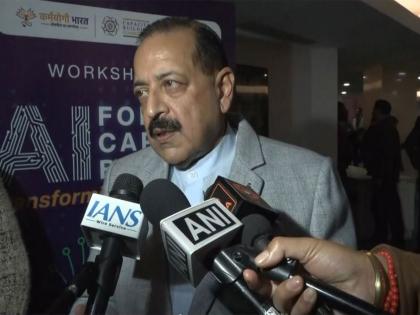
New Delhi [India], January 8 : The Capacity Building Commission has been integrated with Artificial Intelligence to enhance AI-driven capacity building through the iGOT Karmayogi platform, Union Minister for Department of Personnel and Training (DoPT), Jitendra Singh, said on Thursday, addressing an event focused on AI usage for capacity building here in the national capital.
Platforms under iGOT will be embedded with AI to deliver more efficient outcomes in less time.
"The approach is to overlap Artificial Intelligence with the Human Intelligence," the Union Minister said.
The iGOT Karmayogi platform, established under the National Programme for Civil Services Capacity Building - Mission Karmayogi focusses on digital learning and capacity building of Government employees. iGOT has continued to expand rapidly in scale and reach and presently in addition to Ministries/ Departments, most of the States and Union Territories have also been onboarded on the platform.
The next phase of scaling aims at deeper integration of role-based competency frameworks, expansion of multilingual content, and further enhancement of role specific capacity-building plans.
Addresing the event today, the Union Minister underscored the importance of institutional capacity building, technology adoption and continuous learning in governance, describing the Capacity Building Commission as a "path-breaking, out-of-the-box reform" initiated under Prime Minister Narendra Modi's leadership.
Speaking on the evolution of the Commission, Singh said the idea was conceived at a time when political and administrative systems were largely conditioned to maintain the status quo.
Civil servants, he noted, typically operate within long tenures, while political leadership often hesitates to take risks due to electoral cycles. Prime Minister Modi, however, chose to pursue transformative reforms and leave their assessment to public judgment, he said.
Singh recalled that in the initial phase, many ministries and departments were unclear about the Commission's mandate. The transition also required significant cultural adjustment, including closer interaction between ministers, civil servants and professionals from outside government. He said the Commission consciously brought in private sector practices, encouraging mutual learning and the unlearning of outdated processes.
Highlighting the government's early push towards digital governance, Singh pointed out that the Digital India mission launched in 2014 ensured that by the time the Covid-19 pandemic struck, nearly 80% of government functioning had already moved online. As a result, he said, there was minimal disruption to work, particularly in departments such as the Ministry of Personnel and Training.
He also cited Mission Karmayogi as a landmark reform aimed at shifting governance from rigid rule-based functioning to a role-based approach. The mission, he said, addresses a long-standing gap in administrative training by enabling civil servants to continuously upgrade skills relevant to changing roles, rather than relying solely on prior qualifications or authority.
Singh noted that officers are often transferred across diverse sectors, sometimes overnight, and are expected to take charge immediately. Digital learning platforms under Mission Karmayogi, he said, allow them to quickly build domain knowledge and function more effectively, reducing over-reliance on hierarchy and assumptions of expertise.
The minister added that the initiative has since expanded through Mission Karmayogi Prarambh, which now focuses on preparing new recruits for real-world responsibilities beyond examination-oriented learning. He stressed that governance requires continuous learning, not just entry-level qualification.
Referring to technological advancements, Singh said the Capacity Building Commission has aligned itself with the government's AI mission through the iGOT platform, which now has between 1.5 and 2 crore registered users. AI-enabled tools such as AI Sarthi, AI tutors and customised capacity-building plans for ministries are helping create future-ready civil servants and departments. Importantly, he noted, these platforms have been developed indigenously.
Cautioning against over-reliance on technology, Singh emphasised that artificial intelligence should be seen as a tool rather than an end in itself. He warned that without adequate human judgment, there is a risk of "natural intelligence being overtaken by artificial intelligence." He added that while AI has become a fashionable term, its real value lies in practical, hybrid applications.
Summing up, Singh said the future of governance lies in a balanced, hybrid model where technology enhances, rather than replaces, human decision-making, and where continuous learning remains central to effective public service delivery.
Disclaimer: This post has been auto-published from an agency feed without any modifications to the text and has not been reviewed by an editor
Open in app