
Government leading 6G push, aim is to hold 10% of global patents: DG, Cellular Operator Association
By ANI | Updated: April 24, 2026 16:40 IST2026-04-24T22:08:04+5:302026-04-24T16:40:06+5:30



New Delhi [India], April 24 : India's efforts in next-generation telecom technologies are being driven by the government, with ...
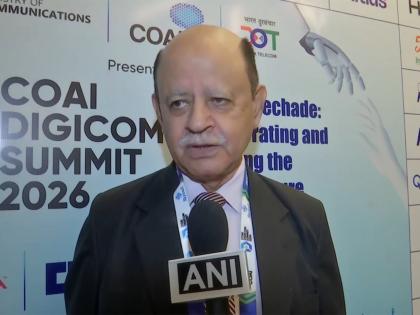
Government leading 6G push, aim is to hold 10% of global patents: DG, Cellular Operator Association
New Delhi [India], April 24 : India's efforts in next-generation telecom technologies are being driven by the government, with a focus on global leadership in 6G standards and patents, Lt General SP Kochar, Director General, COAI Cellular Operators Association of India, has said.
In an exclusive conversation withon the sidelines of Digicom Summit 2026, Kochar spoke about the development of 6G and said telecom operators are not working independently at present, and the initiative is being led by the government in collaboration with industry and academia.
He added that the objective is to move ahead of the world in terms of standards and intellectual property, with a target for India to hold around 10 per cent of global patents in the 6G space.
"Right now, efforts are being made in collaboration with the government, which is taking the lead. The idea is to move ahead of the world in standards and patents, with a goal that India holds around 10 per cent of global patents," he said.
On the ongoing rollout of 5G services, he said the aim is to extend the network to every subscriber across the country. He highlighted that telecom networks are critical for nearly all industries, and improved connectivity will enhance efficiency across sectors.
"Our objective is to take the 5G network to every subscriber across the country. Almost every industry depends on telecom, and without it, much of the work cannot be carried out efficiently," he said.
He added that 5G is not limited to higher speeds and bandwidth, but will also enable a range of new applications and services that will benefit individuals and businesses alike.
Addressing network connectivity issues, Kochar said the use of artificial intelligence (AI) has improved the process of identifying and resolving problems.
"Earlier, this process was manual and time-consuming; now AI is helping identify where issues are occurring and where resources need to be increased," he noted.
He also said that expanding network coverage through installation of more towers remains a key focus area, though challenges such as permission issues from housing societies persist. However, coordinated efforts by the government and industry have led to significant progress.
"Connectivity issues are gradually reducing. Earlier, there were frequent call drops, but now they have reduced, and coverage has improved. The network is becoming more stable," he added.
On satellite communication (satcom), Kochar emphasised the need for uniform regulations across platforms. He said that if similar services are being provided, then there should not be different rules for different players.
He clarified that satcom should be seen as a complementary technology rather than a competing one, with the overall goal being to provide connectivity through multiple channels including satellites, fibre and airwaves.
At the same time, he highlighted concerns over returns on investment in the sector. He said telecom operators are seeking reduction in spectrum costs, urban deployment costs, and license fees to improve financial viability.
"Our investments are high, but returns are not adequate. We have requested the government to address these concerns," he said.
Disclaimer: This post has been auto-published from an agency feed without any modifications to the text and has not been reviewed by an editor
Open in app