
Govt, academia and industry meet at IIT Guwahati to rethink human capital for AI era
By IANS | Updated: January 5, 2026 20:20 IST2026-01-05T20:16:37+5:302026-01-05T20:20:13+5:30


New Delhi, Jan 5 A two-day Working Group Meeting on Human Capital began at IIT Guwahati on Monday, ...
Govt, academia and industry meet at IIT Guwahati to rethink human capital for AI era
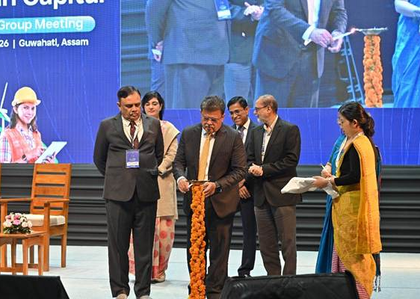
New Delhi, Jan 5 A two-day Working Group Meeting on Human Capital began at IIT Guwahati on Monday, bringing together senior policymakers, academics, industry leaders and practitioners to discuss how India should prepare its people for the age of Artificial Intelligence.
The meeting is being hosted by the Ministry of Electronics and Information Technology (MeitY), the IndiaAI Mission, the Government of Assam, and IIT Guwahati.
The discussions, held on January 5 and 6, are focused on education reform, workforce transition and the adoption of inclusive, human-centric AI.
Chaired by T. G. Sitharam, the meeting is an important lead-up to the India AI Impact Summit 2026, which will take place in New Delhi from February 15 to 20.
The outcomes of the Guwahati meeting are expected to help shape national policy decisions and also contribute to discussions at the global level during the summit.
The inaugural session featured addresses by Syedain Abbasi, Special Chief Secretary of Assam; K. S. Gopinath Narayan, Principal Secretary (IT), Government of Assam; Prof. T. G. Sitharam; Devendra Jalihal, Director of IIT Guwahati; and Shikha Dahiya, Joint Director at IndiaAI, MeitY.
Speakers stressed that human capital will play a central role in India’s AI journey and said the country must move beyond traditional skilling models to embrace lifelong learning and institutional readiness.
Welcoming the participants, Prof. Devendra Jalihal said IIT Guwahati aims to act as a bridge between policymakers, academia, industry and students in shaping future-ready human capital.
He highlighted the institute’s work at the intersection of technology, education and society, and noted that strong student participation shows growing interest in building inclusive AI ecosystems.
Shikha Dahiya explained the vision behind the India AI Impact Summit 2026, saying it will focus on human capital, democratisation of AI resources and responsible AI adoption, especially for the Global South.
She said the IndiaAI Mission is working to build future-ready talent through better compute capacity, indigenous datasets and models, and large-scale AI skilling initiatives across the country.
Prof. T. G. Sitharam said the shift towards an AI-driven economy must be people-centric and inclusive.
He emphasised that India needs strong lifelong learning systems that focus not only on technical skills but also on adaptability, judgement and human values, so that technological progress leads to dignity and opportunity for all.
Highlighting the government’s perspective, K. S. Gopinath Narayan said AI is changing how economies and societies function and has deep implications for human capital.
He stressed the need for continuous learning, micro-skilling and basic AI literacy as essential public capabilities.
Disclaimer: This post has been auto-published from an agency feed without any modifications to the text and has not been reviewed by an editor
Open in app