
Gujarat's stride towards 'Atmanirbhar Bharat': Pulses production doubles in six years
By IANS | Updated: January 5, 2026 17:25 IST2026-01-05T17:21:19+5:302026-01-05T17:25:19+5:30


Gandhinagar, Jan 5 Gujarat has emerged as one of India's leading pulse-producing states, recording a sharp rise in ...
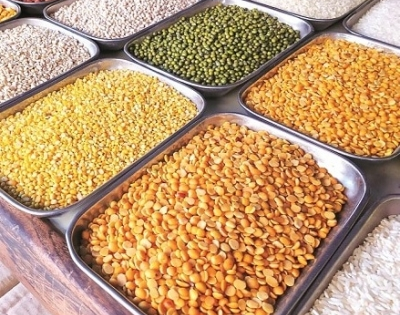
Gujarat's stride towards 'Atmanirbhar Bharat': Pulses production doubles in six years
Gandhinagar, Jan 5 Gujarat has emerged as one of India's leading pulse-producing states, recording a sharp rise in output over the past six years and strengthening the country's push towards agricultural self-reliance.
Driven by better irrigation facilities, higher support prices and improved seed varieties, the state's annual pulse production has crossed 20 lakh metric tonnes, nearly double the levels recorded in 2019–20.
Data from the agriculture department shows that between 2019–20 and 2024–25, the area under pulse cultivation in Gujarat expanded from 9 lakh hectares to 14.39 lakh hectares.
During the same period, productivity increased significantly from 1,173 kg per hectare to 1,495 kg per hectare, reflecting improvements in farming practices and crop management.
As a result, total pulse production rose from 10.58 lakh metric tonnes to 21.52 lakh metric tonnes.
Chickpea continues to dominate Gujarat's pulse basket, accounting for more than 70 per cent of the state's total pulses output.
Chickpea production witnessed a steep rise from 6.36 lakh metric tonnes in 2019–20 to 15.63 lakh metric tonnes in 2024–25.
Gujarat has also made notable gains in pigeon pea (tur/arhar) cultivation, with production increasing by around 45 per cent over the same period, from 2.10 lakh metric tonnes to 3.08 lakh metric tonnes.
Other pulses such as urad, moong and moth bean have also gained ground across different agro-climatic zones of the state.
In 2024–25, urad was cultivated over 1.14 lakh hectares with an output of around 90,000 metric tonnes, while moong covered 1.38 lakh hectares, yielding nearly 1.26 lakh metric tonnes.
Moth bean, suited to dry and semi-arid regions such as Kutch and parts of north Gujarat, along with other minor pulses, was grown over about 72,000 hectares, producing more than 64,000 metric tonnes.
Officials attribute this transformation to a combination of policy and infrastructure interventions.
Irrigation initiatives have ensured greater water availability for rabi and summer crops, encouraging farmers to diversify into pulses.
At the same time, increases in minimum support prices -- ranging between 11 and 31 per cent in recent years -- have made pulse cultivation economically attractive.
The adoption of improved seed varieties developed by state agricultural universities has further boosted yields.
The growing export potential of pulses from Gujarat has added another layer of incentive for farmers, leading to expansion in cultivated area as well as higher productivity.
Together, these factors have positioned pulses as a key growth driver in Gujarat's agricultural sector, reinforcing the state's contribution to India's food security and the broader goal of building an 'Atmanirbhar Bharat' (Self-Reliant India).
Disclaimer: This post has been auto-published from an agency feed without any modifications to the text and has not been reviewed by an editor
Open in app