
Bangladesh diluting Mujibur Rahman's legacy amid radicalisation of institutions
By IANS | Updated: January 11, 2026 00:00 IST2026-01-10T23:58:00+5:302026-01-11T00:00:26+5:30


New Delhi, Jan 10 There is a distinct move in Bangladesh to dilute or erase the legacy of ...
Bangladesh diluting Mujibur Rahman's legacy amid radicalisation of institutions
New Delhi, Jan 10 There is a distinct move in Bangladesh to dilute or erase the legacy of its founding father Sheikh Mujibur Rahman amid the reported radicalisation of institutions and parts of the society.
Recently, authorities at the Dhaka University decided to rename the Sheikh Mujibur Rahman Hall to 'Osman Hadi Hall' after the recently slain radical Islamist leader.
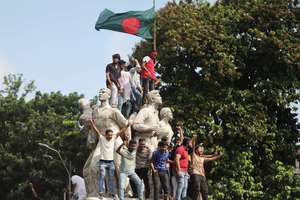
Visuals of protesters atop a statue of Sheikh Mujibur Rahman and defacing the figure marked their celebration of former Prime Minister Sheikh Hasina's resignation in August 2024.
There have since been reports of sculptures and murals of the leader being vandalised in Kushtia, Chittagong, Rangpur, among other places.
Protesters had also vandalised and set on fire Mujibur Rahman's family home in February last year, which was earlier turned into a memorial museum.
Local reportage covered authorities introducing new textbooks early last year where the Awami League founder's reference to the declaration of 1971 independence was replaced with the name of Ziaur Rahman.
Zia, the father of Bangladesh Nationalist Party's (BNP) current leader Tarique Rahman, was among leading figures of the Independence war, and was the country's President from 1977 until his assassination in 1981.
The new textbooks reportedly had also removed the title "Father of the Nation" for Mujibur Rahman.
Much before the Dhaka University, authorities of Islamic University in Kushtia had changed the names of its four residential halls and one academic building last year, which bore names of Sheikh Hasina and her family members.
Again, last year, Bangladesh re-issued currency removing the portrait of the nation's founding President and father of the ousted Prime Minister Sheikh Hasina.
Meanwhile, Islami Chhatra Shibir, the student wing of the Bangladesh Jamaat-e-Islami, returned from oblivion to consolidate its hold on the country's university campuses.
On Saturday, Bangladesh's English news portal 'The Daily Star' observed that the defeats of the students' body affiliated to the BNP "point to deeper challenges" for the Tarique Rahman-led party.
"With just more than a month to go before the national election, Chhatra Dal suffered its latest defeat on Wednesday (January 7), losing the Jagannath University Central Students' Union polls to a panel led by Islami Chhatra Shibir, BNP's main electoral rival," it said.
The Jamaat-affiliated students' organisation earlier won union elections at the Dhaka University, Rajshahi University, Chittagong University, and Jahangirnagar University between September and October last year.
The trend reflects a growing swing towards hardline philosophy, where the outcomes could shape the mandate for February 12 national polls, even if indirectly.
As the election date draws near, the Bangladesh Hindu Buddhist Christian Unity Council (BHBCUC) claimed that communal violence has been increasing "alarmingly".
It said that in December, "there were at least 51 incidents of violence. Among them, there were 10 murders, 10 cases of theft and robbery, 23 incidents involving seizure of homes, businesses, temples, and land, as well as looting and arson."
The removal of Mujibur Rahman's symbols and renaming of university halls after radical figures are widely being interpreted as an attempt to rewrite history and diminish Mujib's foundational role.
It reflects Bangladesh's volatile political transition and the struggle to redefine national identity in the post-Hasina era.
Proponents, however, claim it reflects "people's verdict" and a move to honour contemporary martyrs of political struggle.
However, erasing Mujib's legacy risks deepening divides between his loyalists and new radical-nationalist groups.
For India, which supported Mujibur Rahman during Independence, these changes poses concern, as they signal a shift in Bangladesh's ideological orientation.
Disclaimer: This post has been auto-published from an agency feed without any modifications to the text and has not been reviewed by an editor
Open in app