
Deeply involved in cross-border militancy, Pakistan now presents itself as peacemaker
By IANS | Updated: April 16, 2026 19:40 IST2026-04-16T19:37:57+5:302026-04-16T19:40:26+5:30



Stockholm, April 16 The narrative that Pakistan was a central peace broker in the recently held Iran-US talks ...
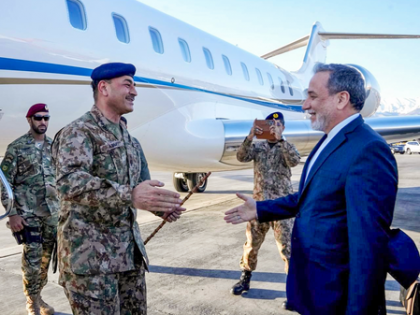
Deeply involved in cross-border militancy, Pakistan now presents itself as peacemaker
Stockholm, April 16 The narrative that Pakistan was a central peace broker in the recently held Iran-US talks held in Islamabad is more of a public relations messaging than geopolitical reality, a report detailed on Thursday.
Writing in the Italian Institute for International Political Studies (ISPI), Jagannath Panda, the Head of the Stockholm Center for South Asian and Indo-Pacific Affairs (SCSA-IPA), asserted that Pakistan may have helped transmit messages or smooth contacts during the meeting, but it did not determine its strategic outcome.
"Islamabad's deeper challenge remains unresolved: a state cannot sustainably market itself as a peace guarantor while carrying unresolved baggage on militancy, selective security policy and chronic domestic fragility. Until those structural issues are addressed, Pakistan’s diplomatic triumphs will continue to look larger in headlines than in history," wrote Panda.
He mentioned that, in reality, the current ceasefire involving Iran, Israel and the United States was ultimately shaped by hard power calculations, deterrence thresholds, energy risks and great-power messaging.
"Pakistan’s geography may have opened doors, but it did not automatically make it the architect of the ceasefire. In reality, larger powers were seeking channels wherever available, and Pakistan was one such channel, not 'the channel'," Panda, who is also a Professor at the Department of Regional and Global Studies at the University of Warsaw, opined.
He spotlighted that concerns over Islamabad's role as peacemaker in the region arise from its long credibility problem on peace and counterterrorism.
"For decades, Islamabad has faced accusations of distinguishing between 'good' and 'bad' militant groups depending on strategic utility. Militant networks operating against India and in Afghanistan have repeatedly damaged Pakistan’s international standing, and when Pakistan itself suffered grievously from terrorism, outside powers remained sceptical of selective enforcement.
"Moreover, Pakistan's own ties with Iran have historically fluctuated. Border tensions, militant activity in Baloch regions, sectarian undercurrents and competition over regional alignments have periodically strained relations. As a result, Tehran is unlikely to rely solely on Islamabad's assurances when its core security interests are at stake," Panda analysed.
Thus, he stated, Pakistan's emergence in the ceasefire episode should be understood less as the rise of a trusted mediator and more as the temporary utility of an available conduit.
"Islamabad was able to be 'in the right place at the right time' because it maintained lines of communication with Iran, workable ties with Gulf actors and relevance to both the United States and China. Yet, being a channel is not the same as being the channel. A true mediator shapes outcomes through accumulated trust and accepted neutrality; Pakistan, by contrast, was useful mainly because larger powers were searching for any practical route to de-escalation," he wrote in ISPI.
Disclaimer: This post has been auto-published from an agency feed without any modifications to the text and has not been reviewed by an editor
Open in app