
Iran's Supreme Leader calls US bases "paper tiger", questions its regional security capability
By ANI | Updated: May 1, 2026 21:10 IST2026-05-02T02:37:31+5:302026-05-01T21:10:16+5:30



Tehran [Iran], May 1 : Iran's Supreme Leader Ayatollah Mojtaba Khamenei on Friday referred to US military bases in ...
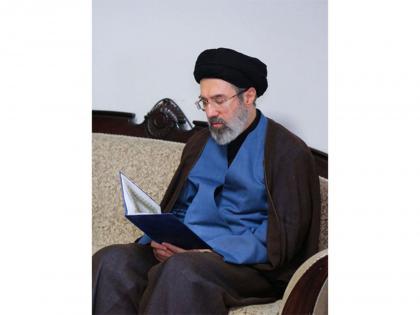
Iran's Supreme Leader calls US bases "paper tiger", questions its regional security capability
Tehran [Iran], May 1 : Iran's Supreme Leader Ayatollah Mojtaba Khamenei on Friday referred to US military bases in the West Asia region as a "paper tiger", questioning their ability to ensure even their own security amid the escalation of tensions between Washington and Tehran.
In a post on X, Khamenei mocked the defensive ability of the US bases in the region while also targeting Washington's regional supporters in a veiled reference to Israel and the Arab countries, which have supported the US during the conflict.
"America's paper tiger bases can't even secure themselves, let alone the regional American-worshippers," the Iranian Supreme Leader stated in his post.
His remarks come amid heightened tensions in West Asia following the ongoing conflict involving Iran, the United States, and Israel, alongside parallel diplomatic efforts aimed at de-escalation.
In another post, the Iranian Supreme Leader also highlighted the strategic and civilisational significance of the Persian Gulf, describing it as more than just a body of water.
"The Persian Gulf is a blessing that transcends a mere expanse of blue waters; it is a part of our identity and civilisation, a point of connection between nations, and a vital pathway for the global economy," the post read.
Earlier on Thursday, Khamenei said that the future of the Persian Gulf would be free from American presence, asserting that foreign forces would have no role in the region except "in the depths of its waters".
According to a message by the Iranian Supreme Leader issued on the occasion of Persian Gulf Day, reported by state broadcaster Islamic Republic of Iran Broadcasting (IRIB), Khamenei said that regional nations share a common destiny and stressed that external powers operating from afar should not interfere in Gulf affairs.
He described the evolving situation as the beginning of a "new order" shaped by Iran's resistance policies and regional dynamics.
"By God's grace and power, the bright future of the Persian Gulf region will be a future without America and in the service of the progress, comfort, and prosperity of its peoples. We share a "fate" with our neighbours in the waters of the Persian Gulf and the Sea of Oman, and the foreigners who greedily commit evil in it from thousands of kilometers away have no place in it except in the depths of its waters. And the chain of this victory, which has been achieved by the grace of God Almighty in the shadow of the measures and policies of the resistance and the strategy of a strong Iran, will be the beginning of a new order in the region and the world," the Supreme Leader said.
He also asserted that Tehran will ensure security in the strategically vital Strait of Hormuz and counter what he described as hostile activities in the region amid geopolitical tensions due to the Islamic Republic's recent confrontation with the US and the power struggle between the two sides over the virtual control of the strategic waterway.
Khamenei further accused Western powers, particularly the United States, of destabilising the region, claiming that foreign military presence has historically led to insecurity and conflict, and further asserted that recent developments demonstrate the inability of external actors to guarantee stability in the Gulf. He also emphasised Iran's intent to play a dominant role in safeguarding maritime routes.
Meanwhile, Iran has submitted its latest proposal aimed at advancing negotiations to end the ongoing West Asia conflict with the US, days after the Islamic Republic submitted a fresh proposal through regional intermediaries to cease its military operations in the Strait of Hormuz, which is likely to get rejected by Washington.
According to the Iranian state media IRNA news agency, Tehran handed over the text of its new proposal to Pakistan, which is acting as a mediator in talks with the United States, on Thursday evening.
This comes after US President Donald Trump on Monday indicated that he is inclined to reject the most recent diplomatic overture from Tehran aimed at halting current hostilities, according to a report by CNN.
The Iranian proposal suggests the restoration of maritime traffic through the Strait of Hormuz, while deferring critical concerns regarding its nuclear programme to future discussions.
Sources familiar with the situation told CNN that Trump expressed his reservations during a high-level briefing with national security aides on Monday.
One source noted that Trump is "not likely to accept the plan," which was formally delivered to Washington within the last few days.
Khamenei accused Western powers, particularly the United States, of destabilising the region, claiming that foreign military presence has historically led to insecurity and conflict, and further asserted that recent developments demonstrate the inability of external actors to guarantee stability in the Gulf.
He also emphasised Iran's intent to play a dominant role in safeguarding maritime routes.
Disclaimer: This post has been auto-published from an agency feed without any modifications to the text and has not been reviewed by an editor
Open in app