
"It's better to get along with China than to fight": Chinese Embassy spokesperson Yu Jing
By ANI | Updated: May 7, 2026 16:25 IST2026-05-07T21:53:29+5:302026-05-07T16:25:07+5:30



New Delhi [India], May 7 : The Chinese Embassy in India signalled a rare moment of rhetorical alignment with ...
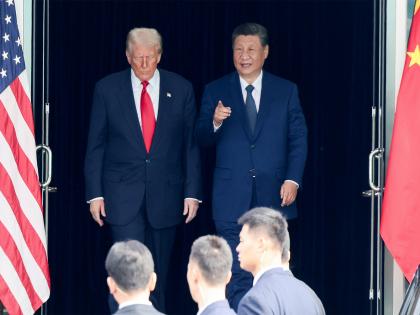
"It's better to get along with China than to fight": Chinese Embassy spokesperson Yu Jing
New Delhi [India], May 7 : The Chinese Embassy in India signalled a rare moment of rhetorical alignment with Washington. Spokesperson Yu Jing took to X to affirm recent sentiments expressed by the US President Donald Trump regarding the necessity of bilateral cooperation.
"President Trump: 'It's better to get along with China than to fight with China. And they feel the same thing.' Indeed, a stable China-U.S. relationship benefits not just our two countries, but the entire world," Yu posted.
{{{{twitter_post_id####🇺🇸 President Trump: "It's better to get along with 🇨🇳China than to fight with China. And they feel the same thing."
Indeed. 🤝 A stable China-U.S. relationship benefits not just our two countries — but the entire world. 🌏#ChinaUS #GlobalPeace #Cooperation #Diplomacy pic.twitter.com/Zlps2oTotd
— Yu Jing (@ChinaSpox_India) May 7, 2026
In a series of high-level diplomatic engagements and public statements this week, China has doubled down on its role as a global mediator, calling for "hard-earned stability" in its relations with the United States and advocating for urgent ceasefires in regional conflicts.
In a post on X, Yu earlier today said, "Only through an early and full ceasefire can there be necessary conditions for a de-escalation. The sovereignty, security and territorial integrity of the coastal countries should be respected, the reasonable concerns of regional countries should be taken seriously, and the legitimate interests of the international community should be protected."
Associated Press: The U.S. government has been asking China to put more pressure on Iran to not only end the war but open the Strait of Hormuz. What would you say about that?
Spokesperson of MFA: Only through early and full ceasefire can there be necessary conditions for a… pic.twitter.com/Cx5mCSSSWK
— Yu Jing (@ChinaSpox_India) May 7, 2026
Echoing the same sentiment, the Chinese Ministry of Foreign Affairs spokesperson Lin Jian emphasised the need to protect the current "hard-earned stability" between the two superpowers. Lin called on both nations to expand cooperation and manage differences to build a "strategic, constructive, and stable" relationship based on mutual respect and peaceful coexistence.
She further noted that the sovereignty and territorial integrity of coastal countries must be respected, and that the "reasonable concerns" of regional actors must be balanced with the interests of the international community.
In a post on X, he said, "China and the U.S. should maintain the hard-earned stability, make good preparations for the important agenda for high-level interactions, expand cooperation and manage differences, and explore the building of a strategic, constructive, and stable China-U.S. relationship, so as to achieve mutual respect, peaceful coexistence, and win-win cooperation."
}}}}China and the U.S. should maintain the hard-earned stability, make good preparations for the important agenda for high-level interactions, expand cooperation and manage differences, and explore the building of a strategic, constructive, and stable China-U.S. relationship, so as… https://t.co/PnMJJL11O0— Lin Jian 林剑 (@SpoxCHN_LinJian) May 1, 2026
The diplomatic push extended to Beijing, where Foreign Minister Wang Yi hosted Iranian Foreign Minister Seyed Abbas Araghchi on Wednesday. The talks focused on Iran's "right to safeguard national sovereignty and national dignity" amid heightening Middle East tensions.
Following the meeting, Araghchi expressed deep confidence in Beijing's mediation efforts.
In a post on X, Araghchi said, "I held constructive talks in Beijing with Chinese Foreign Minister Wang Yi. Both sides reaffirmed Iran's right to safeguard national sovereignty and national dignity. The Iranian side appreciates the four-point proposal put forward by the Chinese side on upholding and promoting regional peace and stability. The Iranian side trusts the Chinese side and expects the Chinese side to continue playing a positive role in promoting peace and stopping war, and supports the establishment of a new post-war regional architecture that can coordinate development and security."
Disclaimer: This post has been auto-published from an agency feed without any modifications to the text and has not been reviewed by an editor
Open in app