
Radical Islamists behind violence in Bangladesh after Hadi's death, says former minister
By IANS | Updated: December 24, 2025 21:15 IST2025-12-24T21:14:35+5:302025-12-24T21:15:19+5:30


Dhaka, Dec 24 Former Bangladesh Minister and Awami League leader Mohammad Ali Arafat on Wednesday alleged that radical ...
Radical Islamists behind violence in Bangladesh after Hadi's death, says former minister
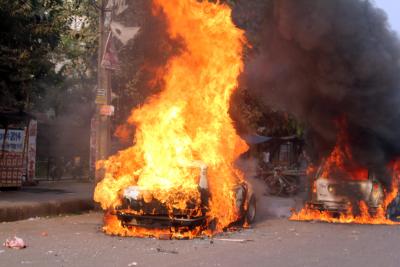
Dhaka, Dec 24 Former Bangladesh Minister and Awami League leader Mohammad Ali Arafat on Wednesday alleged that radical Islamist groups were primarily responsible for the attacks on the country's leading media offices and cultural institutions following the death of extremist leader Sharif Osman Hadi.
"Not only the offices of The Daily Star and Prothom Alo, but also the premises of leading Bangladeshi cultural institutions such as 'Chhayanaut' and 'Udichi Shilpigoshthi' were attacked in Dhaka by violent supporters of Osman Hadi. The attackers were largely drawn from radical Islamist groups," Arafat posted on X.
Highlighting the extremist underpinnings of the violence, the Awami League leader called for an analysis of the motives behind the attacks.
"To understand Bangladesh's political dynamics, it is crucial to examine why these particular cultural institutions were targetted and to analyse the motivations and social profiles of those involved in the attacks. While vandalising Chhayanaut, the miscreants were chanting 'Naray-e-Takbeer, Allahu Akbar'. Doesn't this carry any significance?" he added.
Arafat asserted that radical Islamists appear to be celebrating what they viewed as a victory over symbols of Bangladeshi culture, the spirit of the country's 1971 Liberation War against Pakistan, and its secular values.
"These are the same groups that effectively mounted a sustained confrontation against the Awami League government during July–August 2024. The depth of their hostility toward the Awami League requires serious analysis — whether it stems solely from the party's fifteen years in power or from deeper ideological and political factors," he stated.
Describing the attack on 'Chhayanaut' and 'Udichi Shilpigoshthi' as neither random nor simple vandalism, Arafat said that they reflected a deliberate political assault on the foundations of the 1971 Liberation War and its secular values.
Asserting that the attack on 'Chhayanaut' amounted to an assault on the country's history, he highlighted that the institution emerged as cultural resistance against Pakistan’s erasure of Bangladeshi identity and played a vital role in 1971, inspiring fighters and mobilising global support.
"Today, under the cover of 'anti-India' rhetoric, fundamentalist forces are targetting the pillars of our secular, Liberation War–based identity. Exploiting public emotion, this was a calculated act—not spontaneous anger," Arafat noted.
Earlier on Tuesday, he stressed that the February 2026 polls could contribute to a just, stable and prosperous Bangladesh only if the election is genuinely participatory and preferably endorsed by impartial international observers.
Arafat also expressed concern over the current ban on widely supported political parties in the country by the Muhammad Yunus-led interim government, alleging that the move disregarded guidance from the United Nations, as well as from the UK and Bangladesh's other longstanding allies.
"Without free, fair and inclusive elections, millions of ordinary Bangladeshis will be disenfranchised and simply will not vote at all. Any election held without the participation of all major parties cannot be considered democratic. Muhammad Yunus’s interim government, itself unelected, should not have imposed this restriction on Bangladesh’s voters," he stressed.
Disclaimer: This post has been auto-published from an agency feed without any modifications to the text and has not been reviewed by an editor
Open in app