
South Korea and Japan agree to boost cooperation in supply chains
By IANS | Updated: May 19, 2026 17:30 IST2026-05-19T17:26:37+5:302026-05-19T17:30:24+5:30



Seoul, May 19 South Korea’s President Lee Jae Myung said Tuesday he and Japanese Prime Minister Sanae Takaichi ...
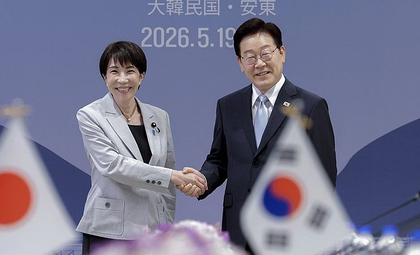
South Korea and Japan agree to boost cooperation in supply chains
Seoul, May 19 South Korea’s President Lee Jae Myung said Tuesday he and Japanese Prime Minister Sanae Takaichi agreed to further enhance cooperation on supply chains amid the continuing conflict in the Middle East, as well as in securing crude oil and Liquefied Natural Gas (LNG) supplies.
Lee made the remarks as he and Takaichi announced the results of their summit held at a hotel in his hometown of Andong, 190 kilometres southeast of Seoul.
"We agreed that close bilateral cooperation is needed more than ever amid the instability in supply chains and energy markets arising from the recent situation in the Middle East," Lee said, adding that they concurred on the need to promptly restore peace in the region, Yonhap news agency reported.
"Based on this shared understanding, our two countries ... resolved to further expand our bilateral supply chain cooperation," the president noted.
He said the two countries also agreed to further strengthen cooperation in the LNG and crude oil sectors, calling them key energy sources for both countries.
"We agreed to expand bilateral LNG cooperation while further strengthening channels for information sharing and communication regarding crude oil supply and stockpiling," he told a live-televised joint press event.
Takaichi separately said the two countries agreed to consider a bilateral swap arrangement on crude oil, petroleum products and LNG, adding that she and Lee also reaffirmed their commitment to pursuing "mutually beneficial" cooperation in artificial intelligence, the economy, security and other areas.
The two leaders also reaffirmed the importance of bilateral cooperation between Seoul and Tokyo, as well as trilateral cooperation with Washington, to ensure peace and stability in the region.
Lee, in particular, referred to upcoming DNA tests on remains found at the site of the wartime Chosei coal mine in Japan's Ube, where the collapse of an underground tunnel in 1942 is believed to have killed more than 100 Korean forced labourers, along with others.
The two countries have worked together to outline procedures and methods for the DNA analysis.
"This will be a small but meaningful first step for both countries in cooperating on historical issues, starting with humanitarian matters," Lee noted.
"Going forward, the possibilities for Korea-Japan partnership are limitless," he said, adding he looks forward to "developing new avenues for cooperation that can drive shared prosperity ... deliver tangible benefits to the people of both nations."
At the opening of the summit, Lee called Japan an important partner, emphasising the need to cooperate more closely to overcome the rainstorm on the global stage.
"Now, a rainstorm is sweeping the global situation. It is a time when cooperation and communication among like-minded countries are needed more than ever," Lee said.
"Judging from the way (our two countries) have worked together to address challenges arising from the international situation, I am reminded how both countries are important partners for cooperation," he added.
The president highlighted the two countries' joint participation in global efforts to ensure freedom of navigation in the conflict-stricken Strait of Hormuz, as well as their cooperation in evacuating their nationals from the Middle East.
"Amid various difficulties, the solid friendship between our countries is shining more brightly than ever," he said.
Takaichi arrived in South Korea earlier Tuesday on a two-day trip that reciprocated Lee's visit to her hometown of Nara Prefecture in January, when the two last met in person as part of the neighbouring countries' ongoing "shuttle diplomacy."
Shortly after her arrival in Andong, Lee welcomed Takaichi with a hug at the entrance of a hotel, wearing a light sky-blue tie that matched the colour of the Japanese leader's suit.
Following their talks in Andong, Lee highlighted that the two leaders have now met four times in just seven months, and said their meeting this week confirms that the countries' shuttle diplomacy has "completely been established."
Later Tuesday, the two leaders will attend a banquet dinner and a performance.
The Japanese prime minister is scheduled to return home on Wednesday morning.
Disclaimer: This post has been auto-published from an agency feed without any modifications to the text and has not been reviewed by an editor
Open in app