
Trump warns Iran, "Better get smart soon"; posts picture with gun and slogan 'No more Mr. Nice Guy'
By ANI | Updated: April 29, 2026 14:20 IST2026-04-29T19:45:25+5:302026-04-29T14:20:05+5:30



Washington, DC [US], April 29 : President Donald Trump has issued a stern warning to Tehran, stating that the ...
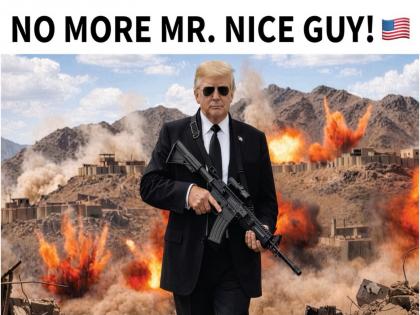
Trump warns Iran, "Better get smart soon"; posts picture with gun and slogan 'No more Mr. Nice Guy'
Washington, DC [US], April 29 : President Donald Trump has issued a stern warning to Tehran, stating that the United States will take a tougher stance if a diplomatic resolution regarding its nuclear programme is not reached soon.
In a post on his social media platform, Truth Social, the President posted a picture of himself holding an assualt rifle and the slogang 'No more Mr Nice Guy'. Trump expressed frustration with the pace of negotiations, asserting that "Iran can't get their act together." He further criticised the Iranian leadership's inability to finalise an agreement, noting, "They don't know how to sign a nonnuclear deal."
The President's remarks come at a time of heightened regional tension and a continued diplomatic stalemate. Highlighting a shift in his administration's approach, Trump warned, "They better get smart soon!"
The post from the US Trump signals a potentially more aggressive policy if Tehran continues to resist the terms proposed by Washington.
The statement follows recent efforts to negotiate a "Trump" deal that would replace previous agreements, which the President has frequently described as insufficient for ensuring global security.
Furthering this stance, Trump has voiced significant dissatisfaction with Tehran's recent diplomatic overtures. He asserted that Washington will not advance negotiations unless the nuclear issue is tackled directly.
The President also claimed that Iran had indicated it was in a "state of collapse" and was consequently pushing for the reopening of the Strait of Hormuz "as soon as possible".
During his assessment, Trump highlighted the global security risks inherent in Tehran's atomic aspirations, warning that should Iran successfully obtain nuclear armaments, "the whole world would be held hostage".
This rejection follows a proposal from Iran focused on an immediate ceasefire in West Asia and the restoration of traffic through the strategically vital Strait of Hormuz. Notably, the proposal sought to postpone discussions on its nuclear programme, missile technology, and existing sanctions.
While Foreign Minister Abbas Araghchi has been conducting a diplomatic blitzvisiting Islamabad and meeting Russian President Vladimir Putin in St Petersburg to secure international backingregional powers have begun to voice their own opposition.
In a meeting held in Saudi Arabia, leaders of the Gulf Cooperation Council (GCC), convened under Crown Prince Mohammed bin Salman, formally rejected what they characterised as Iran's "illegal actions" regarding the closure of the strait and threats to maritime passage.
The GCC summit, which included high-level representation from Qatar, Bahrain, Kuwait, and the UAE, issued a collective call for the return of "security and freedom of navigation" to levels seen before the conflict.
Furthermore, the bloc advocated for enhanced military integration, specifically the creation of shared infrastructure and a ballistic missile early warning system.
As regional and international pressure mounts, reports from The Wall Street Journal suggest that the US administration is bracing for an extended period of economic confrontation.
Trump has reportedly instructed his team to formulate plans for a sustained blockade of Iran, a strategy designed to cripple the Iranian economy and oil exports by strictly controlling maritime access to its ports.
According to The Wall Street Journal, the President prefers this blockade as a more effective, lower-risk alternative to either a renewed aerial bombing campaign or a policy of total disengagement, marking a shift toward a long-term strategy of economic attrition.
Disclaimer: This post has been auto-published from an agency feed without any modifications to the text and has not been reviewed by an editor
Open in app