
Mumbai-Pune Expressway Missing Link in Final Phase; Ghat Section to Be Bypassed Soon — Will This Solve Traffic Issues?
By Lokmat Times Desk | Updated: February 25, 2026 14:08 IST2026-02-25T14:07:56+5:302026-02-25T14:08:37+5:30



Commuters travelling between Mumbai and Pune are likely to get major relief by May, as the much-anticipated missing link ...
Mumbai-Pune Expressway Missing Link in Final Phase; Ghat Section to Be Bypassed Soon — Will This Solve Traffic Issues?
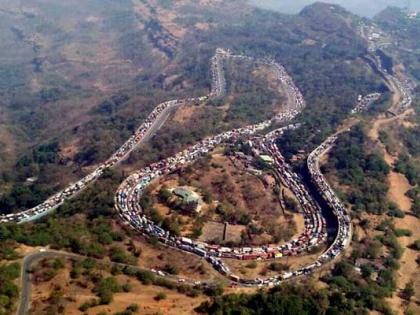
Commuters travelling between Mumbai and Pune are likely to get major relief by May, as the much-anticipated missing link on the Mumbai-Pune Expressway is approaching completion. Being executed by the Maharashtra State Road Development Corporation (MSRDC), the new alignment will help vehicles avoid the accident-prone ghat stretch, easing traffic pressure and cutting travel time by nearly 30 minutes. The route will also be toll-free, ensuring a quicker and more comfortable drive. The recent massive traffic snarl on the expressway had triggered widespread criticism from motorists who questioned the delay in clearing congestion and completing the crucial infrastructure project.
The ambitious project features two expansive tunnels measuring 1.68 km and 8.87 km in length, each with a width of 23.50 metres, making them among the widest globally. These tunnels have been constructed by Navayuga Engineering Company. In addition, two cable-stayed bridges spanning 650 metres and 950 metres have been built by Afcons Infrastructure. Advanced systems have been integrated into the project, including water mist fire suppression, fire hydrants, intelligent traffic management, Supervisory Control and Data Acquisition software, surveillance cameras, SOS facilities, ventilation mechanisms, linear heat detectors, and voice evacuation systems to ensure safety and efficiency.
Cutting-edge engineering methods were adopted during construction, such as the use of the Doka formwork system for the 180-metre pylon and a cantilever form traveller for deck slab work. Ultra-high-performance fibre-reinforced concrete girders and epoxy asphalt-modified concrete were also utilised. According to an MSRDC official, work is currently underway to connect both sections of the cable-stayed bridge, which is expected to be finished within weeks. After this, final touches and road-laying activities will begin. Authorities anticipate completing the entire 13.3-km stretch between Khopoli exit and Kusgaon by April or May before opening it to traffic.
The project promises several advantages, including improved safety, reduced fuel consumption, and smoother travel owing to a flatter gradient. It is expected to eliminate bottlenecks at toll plazas and ensure uninterrupted vehicular movement. However, tankers and trucks transporting inflammable or gaseous materials will not be permitted on this stretch. The route shortens the distance between Lonavala and the Khopoli exit by six kilometres and saves nearly half an hour of travel time. The tunnels pass 180 metres beneath Lonavala Lake, while 5.86 km of the expressway is being widened as part of the broader plan.
Executing the project posed multiple challenges. Tunnel excavation required large-scale muck disposal, oxygen supply for workers, and careful handling of varied rock formations, along with controlled blasting beneath Lonavala Lake. Viaduct construction in hilly terrain faced high wind loads, intense rainfall in the Khandala forest region, and rock blasting close to active traffic corridors. The tallest pylon of the cable-stayed bridge rises 184 metres, and the combined length of both viaducts is 1.6 km. Despite several revised deadlines since the initial March 2024 target, delays were caused by overseas design testing during the pandemic, forest clearances, and heavy monsoon conditions.
Open in app