
At Sivagiri, K'taka CM says religion without ethics becomes tool of domination
By IANS | Updated: December 31, 2025 14:35 IST2025-12-31T14:31:11+5:302025-12-31T14:35:07+5:30


Thiruvananthapuram/Bengaluru, Dec 31 Karnataka Chief Minister Siddaramaiah has said that building an India where people live together in ...
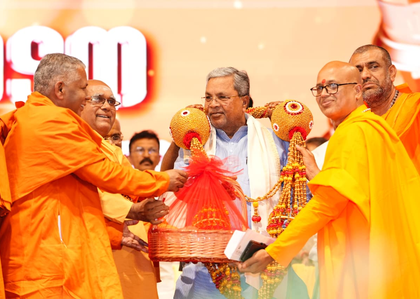
At Sivagiri, K'taka CM says religion without ethics becomes tool of domination
Thiruvananthapuram/Bengaluru, Dec 31 Karnataka Chief Minister Siddaramaiah has said that building an India where people live together in unity amid diversity was the vision of Sree Narayana Guru, and that he had warned society against communalism and casteism.
Addressing the 93rd Sivagiri Theerthadanam festival in Thiruvananthapuram, Kerala, on Wednesday, the Chief Minister stated that Narayana Guru’s goal was to build a compassionate India where people live together despite diversity.
He said Sivagiri reminds us that spirituality is inseparable from equality, reason and human dignity, and that religion without ethics becomes a tool of domination.
“Narayana Guru was not merely a saint; he was a movement for equality and morality. Therefore, the Sivagiri pilgrimage too must take the form of a movement that eradicates caste oppression and leads society towards social justice,” Siddaramaiah said.
“This is the India that Narayana Guru envisioned. This is what India Sivagiri represents. We must together strengthen such an India,” he added.
He said Sivagiri Mutt was not merely a pilgrimage centre but a moral university that represents the conscience of India. “Standing before you at this sacred place is a privilege for me. This is an intellectual and global human movement. This is not a geographical journey but a moral one,” he said.
CM Siddaramaiah said that at a time when politics is drifting away from morality and religion is increasingly being used as a weapon for power rather than ethics, Sivagiri must serve as a moral movement and an inspiration. “The Sivagiri Mutt is functioning like a ‘living Constitution’,” he remarked.
The Sivagiri Theerthadanam, he said, represents India’s foundational anti-communal vision. “When society is being polarised by artificially manufactured hatred, Sivagiri upholds dialogue over dominance, equality over hierarchy, and morality over symbolism,” he said.
Referring to the theme “The role of Sivagiri Theerthadanam in modern nation-building”, the Chief Minister said it was not symbolic but an urgent necessity and a direct response to the crises of the present times. “The driving force behind it is Sree Narayana Guru, who was not just a saint but one of India’s greatest social philosophers,” he said.
CM Siddaramaiah said Narayana Guru did not seek reform within an unjust framework but uprooted the very foundations of injustice. “At a time when Kerala was suffocating under caste discrimination, superstition and inequality, he proclaimed the truth: ‘One caste for humankind, one religion, one God’,” he said.
“This was not merely a poetic statement. It was a direct challenge to the Manusmriti-based hierarchical system rooted in caste discrimination, religious monopoly and social exclusion,” he added.
He said Narayana Guru’s philosophy encompassed the concept of ‘Vishwamanava’ (universal humanism), later articulated by Kannada national poet Kuvempu. “It was a vision of a casteless, fearless and humane society,” he said.
Through the establishment of schools, temples and social organisations, Narayana Guru created platforms that restored self-respect, knowledge and leadership among the oppressed, Siddaramaiah said.
“He understood that caste survives not merely through rituals but through the systematic denial of knowledge. According to him, ignorance was not accidental but a politically created condition to sustain hierarchical social structures,” he said.
The Guru’s core belief of “liberation through education and empowerment through organisation” was not merely a slogan but a theory of social transformation, the Chief Minister said.
“Even before modern nations spoke of ‘human capital’, Narayana Guru argued that education was the most powerful weapon to eliminate deliberate inequality,” he said.
Siddaramaiah noted that Narayana Guru established ITIs, organised industrial exhibitions and encouraged backward communities to become producers rather than dependents.
“He promoted industrial training, skill development and modern agricultural workshops for dignified employment,” he said.
This movement, he said, directly led to the rise of industrial and entrepreneurial communities across the coastal regions of Kerala, Tamil Nadu and Karnataka.
“Narayana Guru did not view employment and industry as threats to culture or spirituality. Instead, he saw them as instruments of social liberation,” Siddaramaiah said.
He added that the Guru’s emphasis on productive labour stood in direct opposition to regressive and narrow economic thinking.
Disclaimer: This post has been auto-published from an agency feed without any modifications to the text and has not been reviewed by an editor
Open in app