
Chhattisgarh: HM Amit Shah inaugurates public service centre in former Maoist stronghold
By IANS | Updated: May 18, 2026 18:40 IST2026-05-18T18:38:36+5:302026-05-18T18:40:09+5:30



New Delhi, May 18 Union Minister of Home Affairs and Cooperation Amit Shah’s Monday visit to Netanar village ...
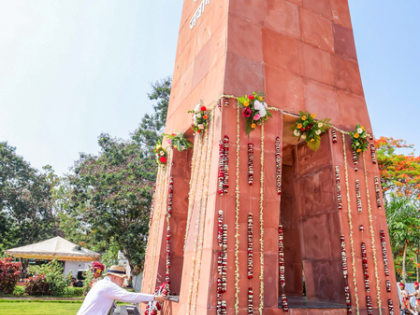
Chhattisgarh: HM Amit Shah inaugurates public service centre in former Maoist stronghold
New Delhi, May 18 Union Minister of Home Affairs and Cooperation Amit Shah’s Monday visit to Netanar village in Chhattisgarh's Bastar district witnessed a moment of deep emotion when he met family members of soldiers Kalendra Prasad Nayak and Pawan Kumar Mandavi, martyred in a Maoist attack in Bijapur.
The Union Minister was inaugurating the “Shaheed Veer Gundadhur Seva Dera”, a public utility centre set up within the premises of the Central Reserve Police Force camp, in what was once part of a Maoist belt.
Their dominance in this region, as well as in other states, had made it one of India’s most critical Left-Wing Extremism hotspots.
Stretching across districts such as Dantewada, Bijapur, Sukma, and Narayanpur, the dense forests, tribal population, and historical grievances over land, displacement, and development created fertile ground for Maoist penetration since the 1990s.
Over the years, the so-called People’s Liberation Guerrilla Army managed to carve out “liberated” or “guerrilla zones”, where local administration barely functioned, and the Maoists ran parallel structures, imposed taxes, ran kangaroo courts, and mobilised youth into armed squads.
Maoists in the larger Bastar division have repeatedly struck security forces and political leaders to project strength and deter state presence.
One of the most notorious incidents was the 2013 attack on a Congress rally in the Jhiram valley of Dantewada, in which 27 people were killed, including senior party leaders such as Mahendra Karma, Nand Kumar Patel, and former Union Minister V. C. Shukla.
The Maoists openly claimed responsibility, calling it a “punishment” for Karma’s role in launching the controversial anti-Maoist militia movement “Salwa Judum”, which involved armed village resistance groups against the insurgents.
Ahead of the 2019 Lok Sabha elections, Bharatiya Janata Party Member of Legislative Assembly Bhima Mandavi and four police personnel were killed when Maoists triggered an improvised explosive device blast on his convoy near Kuakonda in Dantewada.
The attack, part of a broader Maoist campaign to disrupt elections, was immediately followed by multiple other ambushes in the Bastar region, killing at least nine security personnel over a short span.
These incidents underscored how Maoists have timed elections, official visits, and large gatherings to maximise political impact and psychological pressure on the state.
Central and state security forces have been responding over the past decade with large-scale operations in the Bastar-Dandakaranya belt.
In 2025 alone, available reports suggest that more than 30 suspected Maoists were killed in two separate joint operations by the District Reserve Guard, Border Security Force, and other paramilitary units along the Kanker-Narayanpur border.
Another major encounter in late 2025 on the Dantewada-Bijapur border left at least five Maoists and one District Reserve Guard jawan dead, pushing the yearly tally of Maoists killed in Bastar to more than 230 out of nearly 270 across the state.
Over the past decade, such operations have eliminated hundreds of cadres and senior commanders, including the killing of Maoist “chief” Nambala Kesava Rao, alias Basvaraju, in a May 2025 operation in Dandakaranya.
India’s coordinated war on Left-Wing Extremism, including intelligence-driven strikes, road-building, fortified camps, surrendered-fighter schemes, and development spending, has marked the decline of the red menace.
The number of Left-Wing Extremism-affected districts has shrunk from 126 in 2010 to 38 by 2024, with active violence dropping by over 70-80 per cent. Deaths of civilians and security personnel have fallen by 85-86 per cent, according to reports.
Bastar remained one of the last red strongholds, where Maoist strategy shifted from “conventional” military formations to smaller, dispersed units hiding in remote forest patches such as Indravati National Park and blending with local populations.
Local units like the District Reserve Guard and “Bastar Fighters”, which understand local language, terrain, and tribal dynamics, are credited with eroding Maoist networks and weakening their hold on villages.
The Union and Chhattisgarh governments together intensified development schemes, connectivity, and outreach in health and education to counter the ideological appeal of Maoism.
Bastar is thus no longer the unchallenged Maoist fief it once was, with residual insurgency being systematically eradicated through a planned, sustained, multi-pronged security exercise.
--IANS
Disclaimer: This post has been auto-published from an agency feed without any modifications to the text and has not been reviewed by an editor
Open in app