
Delhi Legislative Assembly observes 32nd International Thalassaemia Day with awareness programme
By ANI | Updated: May 8, 2026 19:55 IST2026-05-09T01:22:02+5:302026-05-08T19:55:09+5:30



New Delhi [India], May 8 : The 32nd International Thalassaemia Day was held on Friday at the Delhi Vidhan ...
Delhi Legislative Assembly observes 32nd International Thalassaemia Day with awareness programme
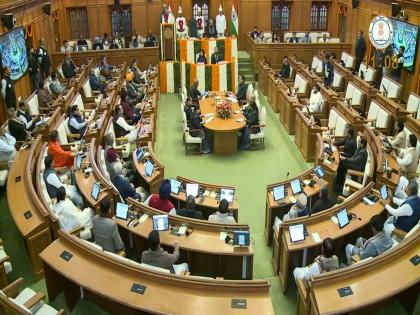
New Delhi [India], May 8 : The 32nd International Thalassaemia Day was held on Friday at the Delhi Vidhan Sabha in collaboration with the National Thalassaemia Welfare Society (NTWS).
Meanwhile, Speaker of the Delhi Legislative Assembly Vijender Gupta conveyed that the proposal regarding making thalassaemia screening mandatory for pregnant women will be discussed in the House for consideration of a Bill on the issue in order to prevent the birth of children affected with Thalassaemia Major. The decision was taken following a request made by the National Thalassaemia Welfare Society.
Former MoS, Hansraj Gangaram Ahir, stated that, "He would take up the matter at the highest level to ensure that all iron chelation medicines are made available and accessible to every thalassaemia patient in the country."
In her inaugural address, Vice-President of National Thalassaemia Welfare Society, Dr. Swaran Anil, observed that, "Due to the dedication and commitment of the medical fraternity, thalassaemia warriors are now enjoying a much better quality of life." She appealed to civil society to donate blood regularly so that children suffering from thalassaemia do not face shortages of blood. She also expressed gratitude to nurses and healthcare workers for the compassion and dedication they continue to show in caring for thalassaemia patients.
Senior Expert, National Health Authority, Vinita Srivastava, highlighted the role of the e-RaktKosh portal in making blood more accessible and available across the country and termed it, "Important technological intervention in strengthening blood transfusion services."
Vice-President, Indian Society of Hematology and Blood Transfusion and Head of the Department of Hematology, AIIMS Delhi, TD Dhariyal informed that, "Thalassaemia patients are entitled to several benefits under the Rights of Persons with Disabilities Act, 2016, including reservation in education and protection against discrimination." He stated that thalassaemia patients can approach the State Commissioner for Persons with Disabilities in cases of violation of their rights, similar to persons suffering from other recognised disabilities.
Addressing the gathering, General Secretary, National Thalassaemia Welfare Society, Dr. J. Arora stated that, "Standard guidelines on thalassaemia management and prevention are now available and the need of the hour is to translate knowledge into practice." He emphasised that only small institutional-level initiatives are required to implement these guidelines in letter and spirit.
He informed that, "The annual cost of treatment of a thalassaemia child ranges between Rs. 50,000 and Rs. 2 lakh, and if left untreated, the lifespan of affected children may be restricted to one to five years." Dr. Arora further stated that thalassaemia patients receiving adequate blood transfusions and optimum iron chelation therapy can live near-normal lives.
During the programme, experts highlighted that "Nearly 5 crore Indians are carriers of the thalassaemia trait, though they do not exhibit symptoms. The risk arises when both husband and wife are carriers, in which case every pregnancy carries a 25 per cent chance of producing a child affected with Thalassaemia Major, a condition requiring lifelong blood transfusions. It was noted that nearly 12,000 to 15,000 children with Thalassaemia Major are born annually in India."
Experts stressed that the "The birth of a child with Thalassaemia Major can be prevented through carrier screening before conception or during early pregnancy. If only one parent is a carrier, no special precaution is required, as the child cannot develop Thalassaemia Major. However, if both parents are carriers, antenatal diagnosis can be conducted at 10-11 weeks of pregnancy following genetic counselling. In cases where the foetus is diagnosed with Thalassaemia Major, families may legally opt for medical termination of pregnancy."
The facility for antenatal diagnosis is available free of cost at Lok Nayak Hospital, Delhi.
Disclaimer: This post has been auto-published from an agency feed without any modifications to the text and has not been reviewed by an editor
Open in app