
From voter turnout percentage in mere 40s to over 90 now: West Bengal’s polling history
By IANS | Updated: May 1, 2026 21:45 IST2026-05-01T21:40:54+5:302026-05-01T21:45:17+5:30



New Delhi, May 1 Voters’ turnout in West Bengal, at 92.47 per cent in this year’s Assembly election, ...
From voter turnout percentage in mere 40s to over 90 now: West Bengal’s polling history
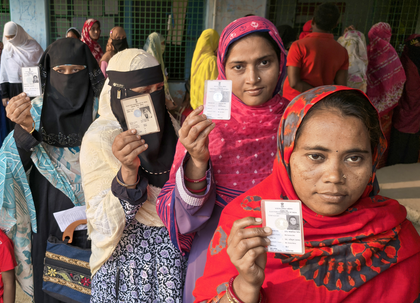
New Delhi, May 1 Voters’ turnout in West Bengal, at 92.47 per cent in this year’s Assembly election, has surpassed the previous high of 84.72 per cent registered in 2011, recording the highest-ever poll-participation since Independence, as stated by the Election Commission.
Significantly, women voters came out in larger numbers compared to men, registering a percentage of 92.47 against women’s 93.24. Thus, female electors bettered their 2011 turnout, when they marked the till-then highest of 84.45 per cent, marginally overtaking that by males at 84.22. For male voters’ turnout, it was earlier the 1996 Lok Sabha poll which recorded a maximum of 84.27 per cent to women’s 80.86 per cent, where the total participation stood at 82.66.
Though West Bengal has been witnessing higher voter turnout compared to many other states, it took 15 elections before it touched the 70 per cent mark in the 1980 Lok Sabha poll. Scoring a 70.62 per cent overall turnout in that election, participation among men was 72.58 per cent, while 68.18 per cent of women electors came out to vote.
In comparison, the total turnout had registered a meagre 43.12 per cent in the first Assembly election held in 1951 after Independence, and 40.49 per cent in the Parliamentary poll held the same year. It rose to 55.55 and 55.75 per cent, respectively, in the Assembly and Lok Sabha elections of 1962.
Notably, the participation significantly dropped in the 1977 polls, which were the first held after the end of the volatile days of the Emergency declared in India. About 56.15 per cent of voters came out in the Assembly polls, and 60.24 per cent in the Lok Sabha election, which led to the Left Front emerging strong in the state and the Janata government at the Centre. It was clearly a decisive mandate against the then Indira Gandhi-led Congress government, though the turnout remained below the 66.03 per cent of 1967, till then the highest number registered in any Lok Sabha poll.
Before the 2026 mandate, it was the 2011 Assembly election in West Bengal that saw a record turnout with men scoring 84.22 per cent against a massive 84.45 per cent participation by women. It was also marked by another regime change, with the mantle passing from the Left Front after ruling for 34 years consecutively, to the Trinamool Congress-led alliance government.
Since India’s Independence in 1947, West Bengal’s political history has been shaped by three major phases: initial Congress dominance, a long Left‑Front rule, and the more recent Trinamool Congress‑led era. After the 1947 Partition, the state was first led by Prafulla Chandra Ghosh and then by Dr Bidhan Chandra Roy of the Congress, who became its first formal Chief Minister under the 1950 Constitution.
Through the 1950s and 1960s, Congress governments held power, though with interludes, and the late 1960s saw growing instability, frequent coalition experiments, and several spells of President’s rule. The United Front (UF) governments were a crucial interlude in West Bengal’s post‑Independence politics, bridging the early Congress phase and the long Left‑Front rule.
After the Congress lost its earlier dominance in the 1960s, a series of short‑lived UF governments emerged, formed by coalitions of non‑Congress parties such as the Communist Party of India (Marxist), Bangla Congress, and others. These cabinets were unstable, often collapsing amid internal splits and defections, which in turn led to periods of President’s rule and contributed to the perception of political chaos before 1977.
The experiments demonstrated that an anti‑Congress coalition could win elections, thereby laying the organisational and electoral groundwork for the Left Front’s decisive victory in 1977. In that sense, the UF governments were both a symptom of Congress' decline and a political rehearsal for the Left‑driven realignment that followed.
In the 1977 Assembly elections, the Left Front, led by the CPI(M) and headed by Jyoti Basu, swept to power and ended Congress dominance. It went on to rule West Bengal for 34 years – often counted among the world’s longest‑serving democratically elected communist‑led government – mixing land reforms with strong grassroots party organisation.
Who the next will rule the government will be known when the poll results are declared on Monday.
Disclaimer: This post has been auto-published from an agency feed without any modifications to the text and has not been reviewed by an editor
Open in app