
Govt targets to establish 1 blood centre in every district by Dec 2026
By IANS | Updated: April 22, 2026 14:35 IST2026-04-22T14:27:27+5:302026-04-22T14:35:14+5:30



New Delhi, April 22 Approximately 10 per cent of districts in the country currently do not have a ...
Govt targets to establish 1 blood centre in every district by Dec 2026
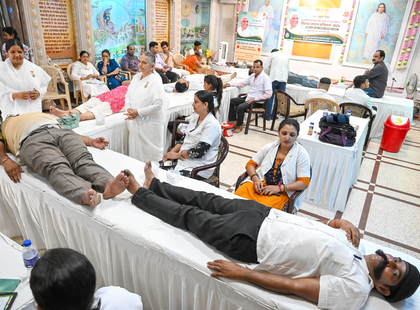
New Delhi, April 22 Approximately 10 per cent of districts in the country currently do not have a blood centre, underscoring the need for accelerated expansion of infrastructure, an official statement said on Wednesday.
Similarly, gaps remain in digital integration, with a significant number of blood centres yet to be onboarded on eRaktKosh and BBMS, limiting real-time visibility and monitoring, according to the outcomes of a national-level meeting convened by Health Ministry on India’s blood transfusion services with states/UTs through video conference.
The review comprehensively assessed the status of blood transfusion services across the country, covering the five critical stages of service delivery: Licensing and Renewal; Donor Screening and Blood Collection; Testing for Transfusion-Transmitted Infections (TTIs) and referral/linkage of reactive donors; Processing, Storage and Issuance; and Reporting and Record-keeping.
Performance was evaluated against a structured framework of 10 key performance indicators (KPIs), using data from eRaktKosh, the Central Drugs Standard Control Organisation (CDSCO), Blood Bank Management System (BBMS) and inspection records of regulatory authorities.
According to the ministry, the review highlighted both progress and key systemic gaps.
“While several states and Union Territories have demonstrated strong performance across multiple indicators, variability persists in areas such as district-level availability of blood centres, licensing compliance, voluntary blood donation rates, referral and linkage of TTI-reactive donors, component separation capacity and real-time digital reporting,” the review found.
Dr Rakesh Gupta, Additional Secretary (Public Health), and Director General, National AIDS Control Organisation (NACO), reiterated the national goal of ensuring timely access to safe blood in every district, with zero transfusion-transmitted infections.
He emphasised the milestone of establishing at least one blood centre in every district by December 2026, in line with the National Blood Policy.
The review also noted encouraging practices in several states and Union Territories, including high levels of voluntary blood donation, strong testing proficiency under External Quality Assessment Schemes (EQAS) and effective referral and linkage mechanisms for TTI-reactive donors.
A set of priority actions for the coming quarters was outlined.
These include strengthening district-level ownership and administrative convergence; ensuring 100 per cent licensing compliance of all operational blood centres; enforcing standard operating procedures for blood collection and donation camps; and scaling up voluntary blood donation through structured outreach and awareness campaigns.
The review further underscored the importance of strengthening referral and linkage systems to ensure that all donors identified with transfusion-transmitted infections are connected to appropriate care and treatment programmes.
Disclaimer: This post has been auto-published from an agency feed without any modifications to the text and has not been reviewed by an editor
Open in app