
Gujarat's new semi high-speed corridor to feature 'Kavach 5.0, 360-degree transport connectivity'
By IANS | Updated: May 15, 2026 19:10 IST2026-05-15T19:07:08+5:302026-05-15T19:10:19+5:30



Gandhinagar, May 15 India's first semi high-speed broad gauge rail corridor equipped with the advanced "Kavach 5.0" train ...
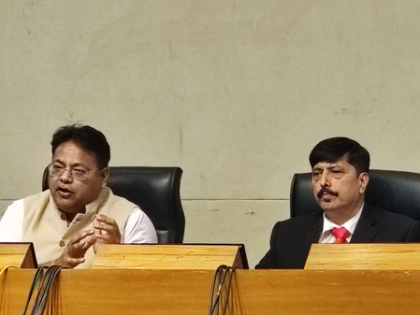
Gujarat's new semi high-speed corridor to feature 'Kavach 5.0, 360-degree transport connectivity'
Gandhinagar, May 15 India's first semi high-speed broad gauge rail corridor equipped with the advanced "Kavach 5.0" train protection system will be developed between Ahmedabad and Dholera in Gujarat after the Union Cabinet approved the Rs 20,667 crore project earlier this week, with railway and state government officials outlining further details on Friday.
The Ahmedabad (Sarkhej)–Dholera semi high-speed double-line railway project, approved by the Cabinet Committee on Economic Affairs chaired by Prime Minister Narendra Modi, will be Indian Railways' first indigenous technology-based semi high-speed rail project and is planned as a model for future expansion of similar corridors across the country.
Officials said the 134-km corridor would be the first in the world where a semi high-speed train runs at 220 km per hour on a broad gauge track.
The route has been designed for a maximum speed of 220 km per hour and an operational speed of 200 km per hour.
Namo Bharat trains are expected to operate on the corridor in future.
Ahmedabad Divisional Railway Manager Ved Prakash said the trains would be equipped with the "Kavach 5.0" safety system.
"The train will be equipped with the advanced 'Kavach 5.0' safety system, establishing a new benchmark in safety and automatic train protection," he added.
He said that semi high-speed services globally had mainly operated on standard gauge networks until now, while India was preparing to develop a 220 km per hour semi high-speed model on broad gauge infrastructure using entirely "Make in India" technology.
"This is not merely a rail project, but a historic chapter in Indian engineering, self-reliance and railway modernisation," he added.
The corridor will connect Ahmedabad, the Dholera Special Investment Region (SIR), the upcoming Dholera International Airport, and the National Maritime Heritage Complex at Lothal.
Officials said the alignment would run parallel to the Ahmedabad-Dholera Expressway and include 13 stations.
The project includes construction of three mega bridges, 74 km of viaducts, 39 road under bridges and two rail-over-rail bridges, with a total track length of around 293 km.
The Railway Ministry has set a four-year completion target for the project.
Gujarat Chief Secretary Manoj Kumar Das said the project would reduce travel time sharply and strengthen multimodal transport connectivity in the region.
"The Sarkhej-Dholera semi high-speed double-line project will take Dholeras development to a new height," Das added.
According to him, travel time from Sabarmati to Dholera Airport would reduce to 48 minutes, while the journey from Sarkhej to Dholera Airport would take around 38 minutes.
Das said the corridor would provide "360-degree connectivity" by integrating air, road, rail and port infrastructure, while also connecting Lothal, which he described as "historically and culturally significant".
He also added that Metro integration was planned at Sabarmati, Gandhigram and Vastrapur stations, while Sabarmati station would connect with the Mumbai-Ahmedabad bullet train corridor and Moriya would connect with the Dedicated Freight Corridor.
Officials said the project was expected to directly benefit around 284 villages and more than five lakh people.
The corridor is projected to add annual freight capacity of around 20 lakh tonnes, save around Rs 54 crore in logistics costs each year and generate around 91 lakh man-days of employment during construction.
According to project estimates, the rail line could save around 0.48 crore litres of fuel annually and reduce carbon dioxide emissions by nearly two crore kg each year, an environmental impact officials compared to planting around 10 lakh trees.
Union Railway Minister Ashwini Vaishnaw had described the project as "a new beginning in the history of Indian Railways".
"This is not merely a railway line, but a symbol of 'New India's modern, fast and self-reliant transport system'," Union Minister Vaishnaw said, adding that the corridor would provide momentum to the vision of "Atmanirbhar Bharat".
The project is being developed under the PM Gati Shakti National Master Plan aimed at improving multimodal connectivity and logistics efficiency nationwide.
Disclaimer: This post has been auto-published from an agency feed without any modifications to the text and has not been reviewed by an editor
Open in app