
IANS Year Ender 2025: Key Supreme Court judgments of 2025
By IANS | Updated: December 31, 2025 16:35 IST2025-12-31T16:32:50+5:302025-12-31T16:35:07+5:30


New Delhi, Dec 31 From reinforcing constitutional equality and free speech to issuing far-reaching directions on sanitation, judicial ...
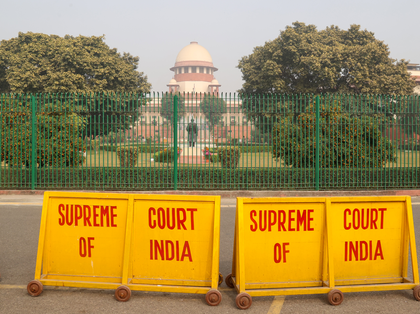
IANS Year Ender 2025: Key Supreme Court judgments of 2025
New Delhi, Dec 31 From reinforcing constitutional equality and free speech to issuing far-reaching directions on sanitation, judicial appointments and human dignity, the Supreme Court delivered a series of landmark rulings through the year 2025. Here is a round-up of some of the most significant judgments.
Residence-based PG medical quota unconstitutional:
The Supreme Court ruled that residence or domicile-based reservation in post-graduate medical courses under the state quota is constitutionally impermissible. Holding that such a reservation runs counter to the idea of citizenship and equality. A 3-Judge Bench said merit cannot be compromised at the PG level. While a limited degree of residence-based preference may be permissible for MBBS courses, extending the same to PG medical education violates Article 14.
Upholding the Punjab and Haryana High Court verdict striking down Chandigarh’s Government Medical College and Hospital PG reservation policy, the apex court stressed that India’s constitutional framework guarantees every citizen the right to seek education and profession across the country.
Separate toilets in courts, a facet of Article 21:
Terming sanitation a basic human right, the Supreme Court directed the construction and maintenance of separate toilet facilities for men, women, persons with disabilities and transgender persons in all court complexes and tribunals. A Bench of Justices J.B. Pardiwala and R. Mahadevan held that access to hygienic washrooms is intrinsic to the right to life and dignity under Article 21 and essential to access to justice.
Expressing concern over the absence of basic amenities even for judges in rural courts, it said the failure reflects a deeper systemic flaw. The apex court ordered High Courts to constitute monitoring committees, directed states and UTs to allocate funds, and mandated surveys and audits to ensure availability, accessibility and hygiene of washroom facilities across judicial premises.
Ad hoc judges -- SC eases appointment conditions:
Modifying its earlier directions on appointing ad hoc judges in High Courts under Article 224A, the Supreme Court relaxed the precondition requiring 80 per cent of the sanctioned strength to be filled. Stressing the urgency of tackling pendency, the apex court allowed appointment of ad hoc judges up to 10 per cent of sanctioned strength, who will primarily act as puisne judges on criminal benches.
The ruling came on a PIL seeking utilisation of Article 224A to clear massive arrears, with the top court reiterating that vacancies must be filled expeditiously to ensure timely justice.
Maintenance allowed even in void Hindu marriages:
Resolving conflicting views, the Supreme Court held that a spouse whose marriage is declared void under the Hindu Marriage Act is entitled to seek permanent alimony and interim maintenance. A 3-judge Bench ruled that Sections 24 and 25 of the Hindu Marriage Act, 1955, make no distinction between divorce and nullity decrees.
Strongly deprecating misogynistic language used by the Bombay High Court, the apex court said branding a woman an “illegitimate wife” violates her dignity under Article 21. It clarified that while the grant of alimony is discretionary and depends on conduct, the remedy under Section 25 is available to both spouses, even where the marriage is void ab initio.
Safeguards against summoning advocates:
In a significant ruling protecting the independence of the Bar, the Supreme Court restricted investigating agencies from summoning lawyers representing accused persons. It held that such a summons can be issued only in exceptional circumstances under Section 132 of the Bharatiya Sakshya Adhiniyam, with prior approval of a senior officer and clear reasons recorded.
The apex court warned that indiscriminate summoning undermines attorney-client privilege and the autonomy of the legal profession, and mandated safeguards to enable judicial review.
In-service judges eligible for district judge posts:
Overturning earlier precedents, a Constitution Bench ruled that judicial officers with seven years’ prior practice at the Bar are eligible for direct recruitment as district judges. Introducing a “combined experience” standard, the apex court said in-service judges with seven years’ cumulative experience as advocates and judicial officers can compete with lawyers, ensuring a level playing field.
The ruling, applicable prospectively, directed states to frame uniform recruitment rules and reaffirmed the 50:25:25 quota for district judge appointments - 50 per cent by promotion, 25 per cent by limited departmental exam, and 25 per cent by direct recruitment from the Bar.
Beggars’ homes must uphold dignity:
Calling for a paradigm shift, the Supreme Court held that beggars’ homes cannot function as quasi-penal institutions. Emphasising Article 21, it issued a series of guidelines mandating medical screening, hygiene, potable water, nutrition audits, skill development, legal awareness and independent inspections.
The top court ordered accountability for custodial deaths due to negligence, including compensation and disciplinary action, and directed the Centre to frame model guidelines for uniform implementation nationwide.
Stray dogs -- sterilise, immunise, return
Balancing public safety and compassion, the Supreme Court modified its earlier directions on stray dogs, ordering that captured dogs be sterilised, vaccinated and released in their original territories, except in cases of rabies or aggression.
Expanding proceedings pan-India, it sought a uniform policy while stressing dedicated feeding spaces and warning against obstruction of civic action. The ruling came amid public debate on safety, animal welfare and constitutional values.
RG Kar case -- SC hands over to Calcutta HC:
The Supreme Court transferred its suo motu proceedings on the rape and murder of a junior doctor at RG Kar Medical College to the Calcutta High Court for continued supervision. Holding that parallel proceedings served no purpose, it directed the CBI to share status reports with the victim’s parents.
Earlier, the top court had constituted a National Task Force (NTF) on hospital safety and related concerns.
Poetry and free speech protected:
Quashing an FIR against Congress MP Imran Pratapgarhi, the Supreme Court held that mere dislike of views cannot justify criminal prosecution.
Stressing that poetry, literature and art enrich human life, a 2-judge Bench ruled that the Instagram video in question did not incite unrest.
No ‘deemed assent’ to Bills:
Answering a Presidential reference, a Constitution Bench held that courts cannot impose timelines on Governors or the President for granting assent to Bills, and that the concept of “deemed assent” violates the separation of powers.
While Governors cannot indefinitely withhold assent, the apex court clarified their constitutional options and limited judicial intervention to directing action within a reasonable time. Earlier, a two-judge Bench, invoking Article 142, treated ten Bills in Tamil Nadu as deemed to have been assented to after prolonged delay by Governor R.N. Ravi and set a three-month deadline for gubernatorial and presidential decisions.
Other key rulings:
The year also saw the Supreme Court dismissing a PIL challenging gender-specific dowry and domestic violence laws, refuse judicial probes into terror attacks, order an AHRC (Assam Human Rights Commission) inquiry into alleged fake encounters in Assam, issue nationwide road safety directions, clarify that individual judges cannot recommend “senior” advocate designations, and strongly criticise scandalous attacks by BJP Lok Sabha member Nishikant Dubey on the judiciary.
Disclaimer: This post has been auto-published from an agency feed without any modifications to the text and has not been reviewed by an editor
Open in app