
India's Chabahar port project again facing choppy waters amidst US warning
By IANS | Updated: January 13, 2026 15:05 IST2026-01-13T15:04:38+5:302026-01-13T15:05:06+5:30


New Delhi, Jan 13 While US President Donald Trump’s recent warning that any country trading with Iran could ...
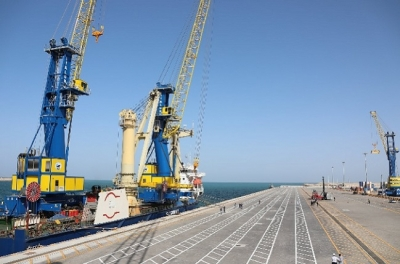
India's Chabahar port project again facing choppy waters amidst US warning
New Delhi, Jan 13 While US President Donald Trump’s recent warning that any country trading with Iran could face an additional 25 per cent tariff has direct implications for India, any choppy waters ahead may affect future operations at the Chabahar port as well.
India is among Iran’s top business partners, as are China, Turkey, the UAE, Pakistan, and Armenia.
The proposed addition will compound earlier US duties, which included a 25 per cent reciprocal trade tariff plus an equal amount as a punitive measure for buying Russian oil. The extra surge was added since Moscow’s oil fell under Western sanctions due to the war in Ukraine.
Now, any effect on Chabahar port operations could pose a strategic risk for India, the project being New Delhi’s counter to Pakistan’s Gwadar Port, built with Chinese support.
India and Iran signed a 10-year agreement in May 2024 to develop the Shahid Beheshti terminal. But the US Secretary of State revoked the sanctions exception issued in 2018 under the Iran Freedom and Counter-Proliferation Act (IFCA) for Afghanistan reconstruction assistance and economic development, effective September 29 last year.
India secured a short exemption, allowing continued operations and development till April this year.
Meanwhile, New Delhi engaged with Washington in sanction negotiations and trade talks. Thus, India could continue developing and operating the terminal at least for some time without facing punitive sanctions from the United States.
The port is crucial for India’s access to Afghanistan and Central Asia, allowing it to bypass Pakistan for trade and connectivity.
The extension was seen as a diplomatic win for India, especially amid broader tensions involving Washington’s sanctions on Iran and Russia.
New Delhi’s $500 million investment and its 10‑year agreement to run the Shahid Beheshti terminal are now exposed to secondary sanctions, complicating trade routes to Afghanistan and Central Asia.
According to a US Congressional research paper from August last year, Washington’s sanctions on Iran are aimed "to deter, constrain, and encourage change in the adversarial behaviour of the Iranian regime" since the 1979 Revolution.
"The Carter Administration initially imposed sanctions to press for the release of US Embassy staff taken as hostages in 1979; the executive branch and Congress expanded US sanctions in the 1980s and 1990s," it cited.
It further mentioned the 118th Congress enacting "a number of Iran-related sanctions measures, mostly as part of the emergency national security supplemental" passed in the wake of Tehran’s "unprecedented direct attack against Israel in April 2024".
Among those measures is an act that directs the President to impose sanctions on port operators, refineries, and other entities linked to Iranian oil.
In case the White House now decide to re-exercise that power with force, Indian companies involved in Chabahar could face restrictions in US markets, leading to uncertainty over financing and insurance. Global banks and insurers may avoid transactions linked to Chabahar, slowing port operations.
Additionally, with its border with Pakistan closed due to intermittent firefights, Afghanistan’s access to sea trade via Chabahar was an alternative that could face disruptions, affecting humanitarian supplies too.
For New Delhi, additional sanctions and punitive tariffs could further complicate ongoing trade negotiations with Washington. The current waiver, valid until April 2026, had given India a window to continue operations and assess future developments at Chabahar. New Delhi is expected to use this time to strengthen its regional ties and infrastructure investments, which are critical to India's economic and geopolitical strategy for Central Asia and beyond.
Disclaimer: This post has been auto-published from an agency feed without any modifications to the text and has not been reviewed by an editor
Open in app