
Rice University deepens India push across AI, Healthcare and research partnerships
By ANI | Updated: May 13, 2026 22:20 IST2026-05-14T03:45:04+5:302026-05-13T22:20:09+5:30



New Delhi [India], May 13 : Rice University is positioning India as a central pillar of its long-term global ...
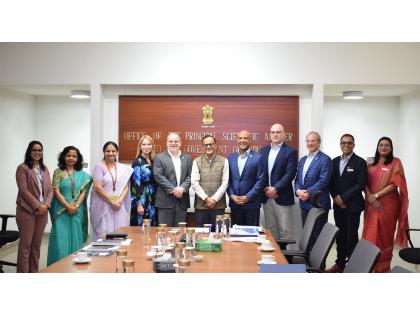
Rice University deepens India push across AI, Healthcare and research partnerships
New Delhi [India], May 13 : Rice University is positioning India as a central pillar of its long-term global strategy focused on research, innovation and higher education collaborations, according to senior university leadership during their recent visit to the country.
According to the release, the delegation, led by Reginald DesRoches, President, Rice University, David Sholl, Executive Vice President for Research, Rice University, and Caroline Levander, Vice President for Global Strategy, Rice University, outlined plans to deepen collaborations with Indian institutions across AI, healthcare innovation, neuroscience, energy transition and advanced scientific research.
University leaders said India's rapidly growing STEM ecosystem, expanding research infrastructure, and focus on innovation-led growth strongly align with Rice's long-term priorities.
Speaking toon expanding international academic ties, Rice University President Reginald DesRoches said, "This is my third trip to India during my tenure as president. We have visited many institutions during this period, as international collaboration is a core pillar of our strategic plan. Our vision of being a global university means partnering with the top-tier institutions of the world. This creates immense opportunities for our students to learn from and work with leading minds, while allowing our faculty members to engage in deep research."
"We have visited several universities over the past few years, and we will continue to return to forge stronger partnerships here. In the past, we signed key cooperation agreements with the Indian Institute of Science (IISc) and IIT Kanpur. Moving forward, we hope to establish additional institutional partnerships," he added.
Meanwhile, Rice University Executive Vice President for Research, David Sholl, told ANI, "The pillars of research at Rice really resonate with the R&D needs of the Indian context. Our faculty are incredibly passionate about conducting research in areas that improve global well-beingfocusing not just on things relevant within the US, but on solutions that will affect people around the world. Because we are based in Houston, the energy capital of the United States, we are used to thinking about challenges on a very large scale. This positions us exceptionally well to address the kinds of strategic research challenges that are highly relevant across the Indian economy."
Rice University Vice President for Global Strategy Caroline Levander said the university has built strategic partnerships with leading Indian institutions, including IITs and IISc, covering joint research, co-supervised PhD programmes and student exchanges.
Speaking to ANI, Levander said, "We have been fortunate over the last three years to visit some of India's very best institutions across the country, from IIT Kanpur to the Indian Institute of Science (IISc) in Bengaluru to IIT Madras. We have developed strategic partnership agreements with those institutions, which include research resources for faculty, co-supervised PhD dissertations, and academic opportunities for students at every level. On this trip, we met with IIT Delhi, and tomorrow we will be meeting with IIT Bombay. We hope to develop the next layer of deep collaborations through these visits."
Rice leadership also pointed to India's growing emphasis on mission-driven research through initiatives such as the Anusandhan National Research Foundation (ANRF) and broader India-US cooperation under the Initiative on Critical and Emerging Technology (iCET), as stated in the release.
The university said it is actively engaging with institutions including IIT Delhi, IIT Madras, IIT Kanpur and IISc Bengaluru. Ongoing collaborations include joint research projects, faculty exchange programmes, student mobility initiatives and co-supervised doctoral training models, added the release.
Caroline Levander said Rice Global India has already built significant momentum in the last 18 months, including three joint research projects funded and running under the Rice-IIT Madras collaboration, active collaborations with IIT Kanpur and IISc generating joint publications, and a co-supervised doctoral training pilot currently in development with IISc.
She also said an Infosys partnership is near finalisation, which will enable Rice PhD students to undertake 16-24-week funded research internships in India. In addition, advanced conversations are underway with leading Indian philanthropic institutions in the areas of healthcare and education.
Rice officials said the university is also exploring partnerships involving Indian startups, philanthropic organisations and industry ecosystems.
Artificial intelligence and responsible AI governance emerged as one of the key themes during the visit.
David Sholl said ethical and responsible AI is becoming one of the most important global research areas and cannot be approached only through a Western or US-centric framework.
"One of the key aspects of ethical AI is understanding the global context, how AI may be used differently in India compared to the United States," he said.
Rice leadership believes India's scale, diversity and digital public infrastructure make it an important environment for developing globally relevant AI frameworks and applications.
The university also said AI research at Rice is closely integrated with healthcare, neuroscience, engineering and public-impact applications rather than functioning as a standalone discipline.
Healthcare innovation and brain research are also emerging as major focus areas for collaboration with Indian institutions.
During the visit, the delegation interacted with researchers at IIT Delhi working on stroke rehabilitation technologies and patient recovery systems.
Sholl said several innovations being developed in India could also have applications within the American healthcare ecosystem.
"There are many things we saw in India that could be fantastically useful within the US healthcare system as well," he said.
Rice University also highlighted the role of the Rice Brain Institute, which works on brain injury, neurodegeneration and mental health research through collaborations spanning neuroscience, engineering and AI.
The university leadership said India's growing neurological disease burden, engineering talent and healthcare infrastructure make it a significant long-term partner for research in this domain.
Rice leadership identified ethical AI, healthcare innovation, brain and neurological research, energy transition, climate science, sustainable cities and advanced materials as key areas driving future India-US collaboration.
Reginald DesRoches said India and the United States are increasingly working on similar global-scale challenges.
"The problems India is working on are very similar to the problems we are working on at Rice," he said, adding that Rice-India engagement began in 2020 and the current visit is aimed at deepening existing collaborations.
Student and faculty mobility also remains central to Rice's India strategy.
According to Caroline Levander, Indian student enrollment at Rice has increased by nearly 60 per cent over the last four years, particularly across computer science, engineering, business and professional master's programmes.
The university said it wants to further expand joint research opportunities, faculty collaborations, internship pathways and doctoral exchange programmes, while also creating more opportunities for American students to study and conduct research in India.
Rice University said it generated approximately USD 190 million in sponsored research in fiscal year 2024 and holds a Carnegie R1 classification for very high research activity.
University leaders said India represents one of Rice's most significant international investments under its broader "Momentous" strategic vision.
"This is a dynamic country with tremendous talent and strong alignment with the global problems we are trying to solve," DesRoches said.
Disclaimer: This post has been auto-published from an agency feed without any modifications to the text and has not been reviewed by an editor
Open in app