
Sacred confluence: How Piprahwa relics can strengthen Ladakh's social fabric
By ANI | Updated: April 29, 2026 07:55 IST2026-04-29T13:21:58+5:302026-04-29T07:55:03+5:30



Ladakh [India], April 29 : The forthcoming exposition of the sacred Piprahwa relics in Ladakh represents far more than ...
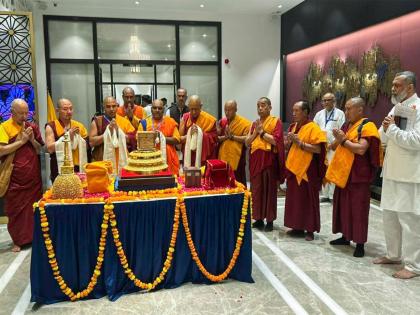
Sacred confluence: How Piprahwa relics can strengthen Ladakh's social fabric
Ladakh [India], April 29 : The forthcoming exposition of the sacred Piprahwa relics in Ladakh represents far more than a ceremonial religious event; it is a profound civilizational moment capable of strengthening Ladakh's social fabric, revitalising Buddhist cultural identity, and positioning India as a central node in global Buddhist engagement.
Scheduled as a historic public exposition beginning in early May, the display of the Holy Relics of the Tathagata in Ladakh marks the first time these revered relics are being widely accessible in the region, offering an unprecedented opportunity for spiritual unity and cultural renewal.
At a time when Ladakh is negotiating rapid socio-economic change, the sacred presence of the Piprahwa relics, associated with the Shakya lineage of the Buddha, provides a deeply symbolic anchor capable of strengthening community cohesion, intergenerational identity, and global engagement.
Ladakh's social fabric has always been deeply intertwined with Buddhist traditions, monasteries, and community life. Institutions such as the Ladakh Buddhist Association have long played a central role in preserving cultural continuity, supporting social harmony, and sustaining the region's ethical traditions. The arrival of the sacred relics will reinforce these structures by fostering shared participation across villages, monasteries, youth groups, and women's organisations.
Relic veneration in Buddhist societies is not merely devotional; it is communal. Collective gatherings around sacred relics create spaces for dialogue, reconciliation, and intergenerational knowledge transfer. In Ladakh, where modernisation and tourism pressures are reshaping traditional lifestyles, such a shared spiritual moment can act as a stabilising force. The exposition will encourage collaboration among monastic institutions, civil society groups, and local governance bodies, strengthening bonds that extend beyond religious observance into civic life.
Moreover, the symbolic reunification and public veneration of relics repatriated to India after more than a century reinforces cultural dignity and historical continuity. The reunification of the Piprahwa relic assemblage after 127 years, by India's Culture Ministry, has been widely regarded as a historic milestone for the global Buddhist community. Such symbolic acts carry deep meaning in regions like Ladakh, where identity remains closely tied to sacred geography and collective memory.
One of the most significant aspects of the forthcoming exposition is the enthusiastic response from mainstream Buddhist leadership across India. From Himalayan monastic orders to Buddhist organisations in metropolitan centres, there is growing eagerness to participate, reflecting a broader national consolidation of Buddhist heritage. Senior monks, scholars, and lay leaders from regions such as Ladakh, Himachal Pradesh, Maharashtra, and the Northeast are expected to converge, transforming Ladakh into a living confluence of traditions.
Such gatherings create important platforms for leadership dialogue and consensus-building on shared challenges, including cultural preservation, youth engagement, language revitalisation, and sustainable development. More importantly, they foster a sense of national Buddhist unity that transcends regional and sectarian boundaries. India's Buddhist institutions increasingly recognise that the Ladakh exposition is not merely a regional event but a national spiritual milestone, one that reinforces India's civilizational identity as the land of the Buddha.
Historically, Ladakh functioned as a civilizational corridor connecting India with Central Asia and Tibet. Monks, manuscripts, artistic traditions, and philosophical ideas travelled through this region, establishing Ladakh as a bridge between cultural worlds. The arrival of the Piprahwa relics symbolically revives this historic role.
In the contemporary context, this role acquires renewed diplomatic significance. Buddhist-majority nations such as Sri Lanka, Thailand, Myanmar, Mongolia, Vietnam, Japan, and South Korea maintain deep spiritual ties with India as the birthplace of Buddhism.
Events centred on sacred relics have historically drawn large numbers of devotees across national boundaries, strengthening both spiritual and diplomatic connections. The Ladakh exposition, therefore, has the potential to become a defining moment in Buddhist outreach, deepening ties with partner nations while enhancing India's cultural presence in Asia.
Beyond its spiritual importance, the exposition also presents a major opportunity for tourism-led development in Ladakh, blending faith with sustainable economic growth. Religious tourism centred on sacred relics has transformed regions across the Buddhist world, drawing large numbers of pilgrims and generating employment, infrastructure development, and thriving cultural enterprises. Past relic expositions have demonstrated how spiritual events can create lasting economic and social benefits.
For Ladakh, this could translate into increased demand for local guides, artisans, hospitality workers, and transport providers, while giving renewed momentum to traditional crafts such as thangka painting, ritual art, and handwoven textiles. Cultural entrepreneurship, through heritage tours, monastery visits, and storytelling traditions, can further strengthen community livelihoods. Infrastructure improvements and better visitor facilities developed for the exposition will benefit both pilgrims and residents. At the same time, local youth will gain new opportunities as translators, cultural interpreters, and heritage ambassadors.
Ladakh's tourism already revolves around its monasteries and sacred landscapes, attracting visitors from across the world. The Piprahwa relic exposition adds a new dimension, elevating Ladakh from a scenic destination to a globally recognised spiritual epicentre and strengthening both its economy and cultural standing.
One of the most enduring impacts of the exposition may be psychological rather than economic. For Ladakhi youth navigating the pressures of globalisation, cultural affirmation plays a vital role in shaping identity and resilience. The presence of sacred relics in their homeland reinforces pride in heritage and strengthens connections to ancestral traditions.
Schools, monasteries, and youth groups can use the exposition as an educational platform, organising lectures, cultural exhibitions, and volunteer initiatives that deepen historical awareness. Such engagement fosters a generation that is culturally rooted yet globally aware, a crucial balance in regions undergoing rapid transformation.
The Piprahwa relic exposition also carries strategic significance for India's international engagement. Buddhism remains one of India's most powerful civilizational linkages with Asia, serving as a foundation for cultural diplomacy and people-to-people exchange. By hosting the exposition in Ladakh, India positions the region as a focal point of transnational Buddhist engagement, enhancing its visibility among global Buddhist communities and reinforcing India's leadership in cultural diplomacy.
Ultimately, the significance of the Holy Piprahwa Relic Exposition lies in its ability to transform spiritual reverence into lasting social cohesion. In Ladakh, where community life is deeply rooted in monasteries and shared rituals, the collective veneration of sacred relics can nurture trust, unity, and resilience across generations. It offers Ladakh an opportunity to reaffirm its identity as a living Buddhist cultural landscape while revitalising heritage-based livelihoods and inspiring renewed confidence among younger generations.
Disclaimer: This post has been auto-published from an agency feed without any modifications to the text and has not been reviewed by an editor
Open in app