
Thick layer of smog blankets Delhi-NCR, air quality stays in 'severe' zone
By IANS | Updated: December 15, 2025 08:50 IST2025-12-15T08:46:41+5:302025-12-15T08:50:10+5:30


New Delhi, Dec 15 Delhi once again woke up to a thick layer of smog on Monday, as ...
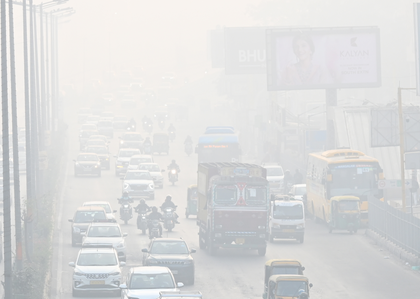
Thick layer of smog blankets Delhi-NCR, air quality stays in 'severe' zone
New Delhi, Dec 15 Delhi once again woke up to a thick layer of smog on Monday, as the air quality remained in the 'severe' category across the National Capital Region (NCR), raising serious health concerns for residents.
At the same time, visibility dropped sharply in several parts of the region.
The overall Air Quality Index (AQI) stood at 457 as of 6 a.m., according to the Air Quality Early Warning System for Delhi.
Visuals from across the national capital showed a dense haze suspended in the air, making it difficult to see even a short distance ahead and affecting early morning movement.
The India Meteorological Department (IMD) had issued a dense fog warning for the morning and forenoon hours, with such conditions reported from the Safdarjung observatory.
The maximum temperature in the city was recorded at 23 degrees Celsius, while the minimum temperature settled at 8 degrees Celsius.
Pollution levels remained alarming across multiple monitoring stations. In the Akshardham area, the AQI was recorded at 493, which falls under the 'severe' category as per the Central Pollution Control Board (CPCB).
Similar conditions were observed in Dwarka Sector-14, where the AQI stood at 469.
At Wazirpur, Rohini and Ashok Vihar, the 24-hour average AQI touched 500, the maximum level recorded by monitoring instruments, underscoring the gravity of the pollution crisis gripping the city.
According to the pollution board, air quality is categorised as 'moderate' when the AQI ranges between 101 and 200, 'poor' between 201 and 300, and 'very poor' between 301 and 400. When the AQI exceeds 400, air quality is classified as 'severe'.
For mitigation measures, levels of 450 and above are termed 'severe plus', though CPCB values do not go beyond 500, a threshold already considered extremely hazardous by the agency.
With Delhi's air quality plunging well beyond critical limits, the Commission for Air Quality Management activated Stage-IV of the Graded Response Action Plan across the entire National Capital Region.
The highest level of restrictions comes into force when the AQI crosses 450 and is aimed at preventing further deterioration while reducing public exposure to toxic air.
Under GRAP Stage-IV, stringent measures are now in place, including a complete halt on construction and demolition activities across Delhi-NCR.
Stone crushers, mining units and associated operations have also been ordered to shut down, as they significantly contribute to dust and fine particulate matter.
Restrictions on vehicles have been further tightened, particularly targeting polluting four-wheelers on major urban roads, as authorities scramble to curb emissions amid the worsening air quality situation.
Disclaimer: This post has been auto-published from an agency feed without any modifications to the text and has not been reviewed by an editor
Open in app