
105-Minute Visit & Questions Galore!
By Vijay Darda | Updated: January 26, 2026 07:13 IST2026-01-26T07:12:12+5:302026-01-26T07:13:14+5:30



The world is trying to decode the meeting between UAE President and Indian Prime Minister
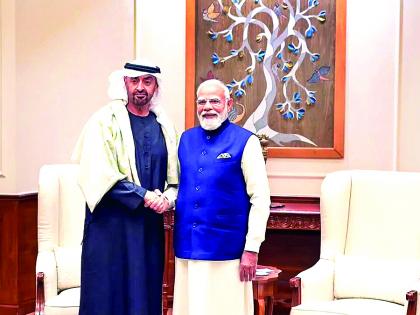
105-Minute Visit & Questions Galore!
The question on everyone’s mind is whether the discussion was limited to what is apparent, or this short meeting covered something much bigger and deeper! These questions will be answered only in time.
First and foremost, I extend my warm wishes to one and all on the auspicious occasion of Republic Day. Jai Hind!
Recently, during my travels, I met a reader who follows my column regularly. He raised an important and thoughtful question. At a time when the country and the state are witnessing intense political activity and numerous domestic issues are demanding attention, why have I been giving priority to international affairs in my recent columns? My response to readers is simple and sincere. Today, the world is so closely interconnected that almost every global development has a direct or indirect impact on India. It is my responsibility to present these evolving situations to readers in clear and accessible language. I do not divide issues into ‘domestic’ and ‘foreign’. I write about what is contemporary and relevant, so that readers remain alert, informed and capable of seeking answers to the questions that naturally arise in their minds.
Against this backdrop, the focus of discussion is the recent visit of the President of the United Arab Emirates Sheikh Mohammed bin Zayed Al Nahyan to India. He came to India for just 105 minutes. This was an exceptionally short visit for any head of state. Setting aside protocol, Prime Minister Narendra Modi personally went to the airport to receive him. From there, both leaders travelled in the same car to the Prime Minister’s residence. Discussions were held, some deals were signed and then Nahyan departed for the UAE. Naturally, a question arose in everyone’s mind: What was the purpose of this visit? The ministry of external affairs shared some details about the deals that were signed, but was that all there was to such a brief visit?
This question is entirely justified because the UAE has emerged in recent years as a formidable and astute player in diplomacy. On the other hand, Prime Minister Narendra Modi is himself regarded as the Chanakya of diplomacy. He has infused remarkable warmth into India’s relations with all countries of the Middle East, be it the UAE, Saudi Arabia, Qatar, Iran or Israel. All are friends of India. The UAE is so close that it permitted the construction of the BAPS Swaminarayan temple in Abu Dhabi. It is encouraging that India and the UAE have reached several agreements in defence, space and special investment sectors, and deals have been signed. However, the major news is that India will receive an annual supply of five lakh metric tonnes of liquefied natural gas from the UAE. This means the UAE has now become the second-largest supplier of LNG to India.
However, all these issues are those that are visible on the surface. The real question is: What subjects lay at the deeper core of this meeting? Was UAE President Sheikh Mohammed bin Zayed Al Nahyan carrying a message so sensitive that it could neither be put on paper nor safely shared even through a secured communication line? Or were the matters such that discussing them face-to-face, without formal records or intermediaries, was the only appropriate course? Was Trump’s Board of Peace also part of these discussions? Trump has constituted this board with the stated objective of promoting peace across the world, with its very first project proposed to be the redevelopment of Gaza. Invitations have been extended to 60 countries, including India, to join the board. It may come as a surprise to many that any country seeking permanent membership is required to contribute one billion dollars. Beyond this, many aspects of the initiative remain unclear. It is noteworthy that China, the United Kingdom, France, Germany, Sweden and several other major countries did not participate in the board’s signing ceremony. Their absence is being described as a boycott. Countries such as Germany, Italy, Russia and Turkiye have maintained complete silence on the matter.
India, too, has chosen not to comment so far, while the UAE has accepted the invitation. This naturally raises the question: Did this issue feature in the discussions between the two leaders? Was the UAE President carrying a specific message? These questions are significant because any political development or instability in the Middle East has a direct impact on India. Moreover, while India maintains excellent relations with Israel and bilateral trade between the two continues to grow steadily, it has also consistently upheld its position in support of Palestine. It is quite likely that Trump would want India to be part of this board. The larger question, however, is that when the United Nations already exists for maintaining world peace, what is the need for such a board?
Another point of curiosity is whether other issues of the Middle East were discussed too during the meeting between the UAE President and the Indian Prime Minister! This is particularly relevant in the light of the strategic mutual defence agreement between Saudi Arabia and Pakistan, under which an attack on one would be considered an attack on the other. Turkiye is expected to join this alliance soon, and reports suggest that Egypt and Somalia are also eager to become part of it. At the same time, tensions persist between Saudi Arabia and the UAE over conflicts in Yemen, Somaliland and Sudan. The UAE would certainly not want Saudi Arabia’s position to become stronger. In the event of a conflict involving Saudi Arabia, the question arises as to who would stand by it. The United States maintains friendly relations with both Saudi Arabia and the UAE, making it unlikely that it would openly side with either. In this context, the UAE looking towards India should not come as a surprise. Speculations around a potential Israel-UAE-India defence pact are gaining momentum. It is only natural to ask whether this subject was also raised during the meeting! Moreover, was the issue of Iran part of the discussion as well? For now, one must wait. Time invariably provides answers to all questions.
The author is the chairman, Editorial Board of Lokmat Media and former member of Rajya Sabha.
