
Art of Steeping Ideas in Politics
By Vijay Darda | Updated: March 9, 2026 05:39 IST2026-03-09T05:37:30+5:302026-03-09T05:39:55+5:30



Last week, while looking at faces smeared with colours during Holi and then Rang Panchami, a question came to ...
Art of Steeping Ideas in Politics
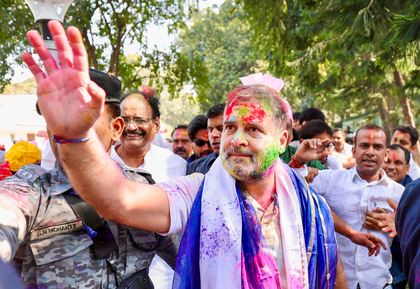
Last week, while looking at faces smeared with colours during Holi and then Rang Panchami, a question came to my mind: Is our politics also becoming so colourful that it is becoming difficult to recognise the real face behind it? Earlier, when people played with gulal and natural colours, it was easy to recognise them. Now, faces smeared with paint, tar and even gutter sludge all look equally disfigured. You may say that Holi has already passed, so why am I still talking about colours? The reason, of course, is politics, where the saying fits perfectly: Ideology has gone to the dogs! Let us pickle our ideas instead.
When people say that ideology has gone to the dogs, it means that ideology no longer holds any importance in politics. Many have even started saying that when ideology does not help achieve the goal of power, it is better to evade one’s gaze from the bull’s eye altogether. The old notion that one should remain steadfast to one’s ideology, irrespective of whether power is achieved or not, has become outdated. This is the new era and politicians too have chosen new paths. I recently met a leader from the Shiv Sena. I asked him how his party was doing. With a sheepish grin he replied, “Oh, these days I’m in the Bharatiya Janata Party.” I also met a leader from the Nationalist Congress Party. When I asked how things were going, he said, “Everything is going very well. There is no other party like the BJP!” He explained that if they do not remain in power, how will they fulfil the expectations of their voters? A journalist sitting next to me raised the issue of ideology. The leader laughed and said, “If we keep clinging to ideology, our youths will pass away in struggle alone! What will we do with ideology... pickle it?” “Leave aside our case, even those closest to Rahul Gandhi have abandoned him!” he added. After getting such answers, I now find myself wondering whether I should first ask which party they belong to these days before asking someone how they are doing.
Of course, one cannot ask such a question to a Leftist leader. Even though China and Russia have abandoned Leftist thinking, our Leftist friends in India still hold tightly to their ideological reins, with a warning -- do not fall for temptations! They insist that they were Leftists, they are Leftists and they will remain Leftists. You may recall that at one time all opposition parties had agreed to make Jyoti Basu the Prime Minister. However, Left leaders Prakash Karat and Harkishan Singh Surjeet vetoed the proposal, saying that the opposition parties did not share their ideology, and therefore Jyoti Babu would not become Prime Minister. At the same time, the BJP too deserves appreciation for its steadfastness regarding ideology. Even when its strength in Parliament was just two members, its leaders did not abandon their ideological stand. Who can forget that when the Congress was at the peak of its dominance, leaders such as Ram Manohar Lohia, Madhu Limaye, Madhu Dandavate and Mrinal Gore continued to struggle for their beliefs? They did not switch sides. You must also remember N D Patil, a prominent farmers’ leader. Despite being Sharad Pawar’s brother-in-law, he remained a strong ideological opponent of Pawar. Indian politics offers many such examples. But times have changed now.
During the recent municipal elections in Maharashtra, someone made a very interesting remark to me: It has become extremely difficult to determine who is with whom and who is against whom. Someone who is seen standing hand in hand with an ally in Mumbai suddenly appears in the rival camp upon reaching Pune. At some other place, the same person is found standing with yet another group. What happened during the elections was enough to completely confuse anyone. In the Brihanmumbai Municipal Corporation (BMC) election, the Bharatiya Janata Party (BJP) and Shiv Sena (Shinde faction) contested together. The Nationalist Congress Party (Ajit Pawar faction) is part of the government, yet it contested the BMC election separately. However, these equations changed in Pune. There, the BJP fought the election on its own, while the Shinde-led Shiv Sena also contested separately. Meanwhile, Ajit Pawar’s faction of the NCP joined hands with Sharad Pawar’s group in Pune. But in Nagpur, the two contested separately again. In Mumbai, the Congress had severed its ties with the Thackeray brothers, yet in Pune it joined hands with them. The Vanchit Bahujan Aghadi, which contested alongside Congress in Mumbai, fought against Congress in Pune. In Chhatrapati Sambhaji Nagar, the ruling allies in the state -- BJP, Shiv Sena (Shinde) and NCP (Ajit) -- all tested their fortunes separately. In Nashik, the BJP went alone, while the Shinde and Pawar groups joined hands. Even the mayoral elections produced strange alliances. In the Bhiwandi-Nizampur Municipal Corporation, the BJP had a clear majority and fielded Sneha Patil as its candidate. However, BJP leader Narayan Chaudhary rebelled. He received support from the Bhiwandi Secular Front, led by Sharad Pawar’s NCP, and eventually became mayor.
A BJP worker expressed his frustration, saying that outsiders who had joined the party were enjoying all the benefits, while long-time members were left merely to spread the carpet for others all their lives. In Chandrapur, Congress was close to securing a majority, but with the support of the Shiv Sena (Uddhav faction), a BJP candidate was elected mayor.
In the current political climate, some people even praise Ramdas Athawale, saying that he is perhaps the most honest leader. He is very clear about his position. He openly says whoever is in power, we stand with them and the one we stand with is in power! In other words, he says exactly what he means without any pretence. Others, however, behave as though the colour on their faces can be wiped off in the blink of an eye and replaced with another. They remove one colour, apply another, and then a third. And they manage to convince voters that they have turned colourful only for the voters’ welfare. The public knows very well that its role is simply to clap... and it continues clapping!
The author is the chairman, Editorial Board of Lokmat Media and former member of Rajya Sabha.
Open in app
