
App Competitor Analysis & Pre-Registration: Win Before You Launch
By Impact Desk | Updated: March 16, 2026 17:59 IST2026-03-16T17:59:05+5:302026-03-16T17:59:30+5:30



The current number of apps competing in the App Store and Google Play is 9.4 million, as of Q1 ...
App Competitor Analysis & Pre-Registration: Win Before You Launch
The current number of apps competing in the App Store and Google Play is 9.4 million, as of Q1 2026, and most of them do not come in with a business proposal. I have seen a number of good developers release great products to complete silence, not due to bad apps, but simply because they have not reached the stage of intelligence. Competitor analysis of apps is no longer optional. It's a table value. And when you are not pre-registering apps in your launch strategy, you are handing over a lead that you will literally never recover.
Blind Launches Don't Go Viral—They Go Quiet
Look. The myth of the garage building and becoming viral overnight? It died in 2019. The app market is monopolized, search-consumed, and mercilessly efficient.
The Statista Mobile App Market Report (March 2026) also shows that mobile app downloads on both platforms are now over 68% through direct keyboard searches rather than by surf discovery. Even that one statistic would make you reevaluate your timing, positioning, and choice of category, even before the first line of code is written.
What matters is that your competitors are providing you with the solutions. You can read their rankings by keywords, user reviews, the rate at which they get updated, the momentum of pre-registrations, and all of that, provided you know where to look.
What an Actual Real Competitor Analysis in the Real App Covers
The majority of developers believe that competitor analysis consists of downloading an app of a competitor and leaving a one-star review. That's not it.
An appropriate competitive intelligence sweep addresses the following:
- Keywords gap analysis—What do your competitors rank on with high-volume and low-competition search terms that you are not even attempting to target yet?
- History of App Store ranking—Are they stable on the chart? Were they spiking on a charged burst, or were they naturally organic?
- Download velocity experimentation—Now, download density will compute the daily install ranges with sufficiently high accuracy so that it can be used as a reference point.
- Review sentiment mining—Where is the vocal user frustration hiding? That's your product roadmap.
- Update frequency—Competitors with updates every 10 days are spending a lot of money. Retention battles might be being lost with those who are coasting on 90-day cycles.
All five of these signals can be displayed in one dashboard by AppPark.ai. I have tried out some app analytics products in early 2026, and the quality of their competitor-tracking service will be of great use to indie developers that cannot afford a Sensor Tower enterprise license.
The Pre-Registration Window: Your Most Underused Growth Lever
In 2026, app pre-registration—which is a built-in feature of Google Play and custom landing pages on iOS—was used unlawfully. Why? Since a majority of developers consider it a vanity metric. They launch, recruit 300 followers, feel better, and leave.
Actual clubs train adaptable data frontline to be able to confirm positioning, A/B test creative in the store prior to a greenback being effectively expended, and create warm re-engagement records before Day 1.
According to an analysis by Eric Seufert, founder of Mobile Dev Memo and a mobile marketing strategist, his analysis of February 2026 pointed out the existence of pre-registration signals as one of the few valid leading indicators of organic chart performance remaining after Apple switched to ATT. Those who disregard them are soaring by pure instinct only.
He's right. Pre-registration conversion rates—what proportion of people who see your store listing convert to registered—inform you as to whether your value proposition is by the time you are locked in to launching.
Tool Comparison: App Competitor Analysis Platforms (2026)
Platform | Competitor Tracking | Pre-Registration Insights | Keyword Intelligence | Starting Price (2026) | Best For |
AppPark.ai | Deep | Yes | Yes | Free tier available | Indie & mid-size devs |
Sensor Tower | Enterprise- grade | Limited | Yes | $1,500/mo | Large studios |
data.ai (App Annie) | Strong | No | Yes | $1,200/mo | Enterprise teams |
MobileAction | Yes | No | Yes | $299/mo | Growth marketers |
AppFollow | Partial | No | Limited | $63/mo | Review management |
Sources: Vendor pricing pages accessed March 2026. AppPark.ai, Sensor Tower, data.ai
Case Study: How One Game Studio Tripled Pre-Registration Figures through Competitor Data
In January 2026, a mid-size casual gaming studio in Southeast Asia (they asked to remain anonymous) also used AppPark.ai for their app store optimization module before making a puzzle game available in a highly saturated market of their category.
They found that there were three things:
- The competitor ranked in the top position had 40% of its reviews containing the term "crashes on Android 14." That was a product gap.
- The screenshots of the second competitor were not updated within 11 months—a visual outside positioning gap.
- The keyword cluster of high volume, consisting of offline puzzle games, with no ads, was untouched.
The third insight that they built their store listing upon was finding what the first competitor failed to fix and building new creative content that performed better than the second. Result? Their pre-registration fund-raiser reached 14,000 signups within 21 days, or about three times their category benchmark. Launch Day 1 made the Top 50 in three markets.
Best Way to Start Your Competitor Analysis Today
Before you finalize your app store listing, not after, audit the keyword rankings of your top 5 rivals with a tool such as AppPark.ai.
- Test your pre-registration campaign at least 3 weeks ahead of time, and test conversion rates by creative variation, and then you can make a commitment to a launch date.
- Competitors update frequency monthly—this informs you of where they are investing their money in their products, and their users are getting frustrated.
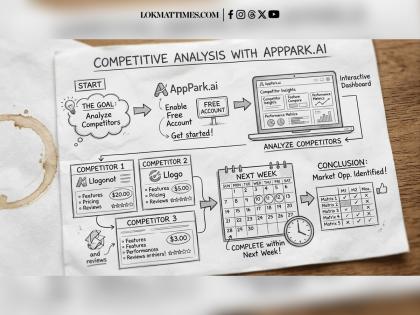
You can use AppPark.ai and enable the free account, then use it to perform the competitive analysis of the top 3 competitors within the next week. The data is sitting there. Your rivals are unaware of the fact that you are reading it.
FAQs:
What is app competitor analysis?
App competitor analysis involves monitoring the ranking of your competitors in keywords, download rates, review sentiment, and store performance to define gaps and opportunities before and after the launch.
How does app pre-registration help growth?
Pre-registration creates a friendly following in advance of a launch, demonstrates heat to the algorithm, and provides you with A/B test data of your store listing before you spend on paid user acquisition.
Which app competitor analysis tool is best for indie developers in 2026?
AppPark.ai provides a feature set as broad as possible at the lowest price accessible to a solo developer and small studio at present, according to 2026 pricing scales.
How many competitors should I track?
Track 3-5 direct competitors. Include 2-3 'aspirational' players—larger players in your industry, whom you can learn further from how to keyword.
Can I do competitor analysis without paid tools?
Partially. You have your own data on Google Play Console and App Store Connect but need third-party platforms to obtain competitor intelligence. The majority of them have free levels to begin with.
Open in app
