
KOSPI's record year sets stage for continued growth in 2026
By IANS | Updated: December 26, 2025 09:10 IST2025-12-26T09:09:04+5:302025-12-26T09:10:19+5:30


Seoul, Dec 26 South Korea's stock market enjoyed a stellar year and outperformed both regional and global peers, ...
KOSPI's record year sets stage for continued growth in 2026
Seoul, Dec 26 South Korea's stock market enjoyed a stellar year and outperformed both regional and global peers, boosted by artificial intelligence (AI) and the government's market reform measures.
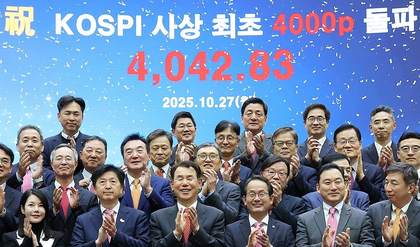
Once hovering around the 2,400 mark, the benchmark Korea Composite Stock Price Index (KOSPI) hit a new milestone on Oct. 27, surpassing the 4,000 level for the first time since the index was introduced in 1983, reports Yonhap news agency.
The KOSPI was the best-performing stock gauge among those of the Group of 20 (G20) nations, rising more than 70 percent since the start of the year.
It even beat the world's largest stock market, as the S&P 500 and the tech-heavy Nasdaq, advanced 17.2 percent and 21.5 percent, respectively.
The unprecedented rally was due to a powerful combination of the global AI boom, strong foreign investment driven by rate cuts and supportive corporate reforms by the new administration.
Promising to lift the KOSPI above the 5,000 level, President Lee Jae Myung has vowed to enhance market transparency, increase shareholder value and reform the capital market.
Currently, a third round of amendments to the Commercial Act is pending at the National Assembly. The revision aims to mandate the cancellation of treasury stocks within one year, a measure widely expected to increase shareholder returns.
More than 20 KOSPI-listed companies shattered their records this year. Samsung Electronics more than doubled and its rival SK hynix nearly quadrupled driven by global excitement over the AI chip supercycle.
Looking ahead, market observers maintained a positive outlook for the local stock market, saying that demand for AI-related infrastructure will continue to be robust in the coming year.
"A number of data centers invested in by major big tech companies are poised to be built around 2026 and 2027," said Park Se-young, executive director of Nomura Securities Co.
She anticipated the KOSPI will reach as high as 5,000 next year, stressing that the trend could positively impact not only local chipmakers, but a wide range of Korean tech companies making up the AI supply chain, spanning from batteries to cooling system providers.
Many others agree the benchmark index will likely continue to climb next year.
Daol Securities forecast the KOSPI to move in a range of between 3,740 and 4,930 in 2026, while Hyundai Motor Securities predicted the KOSPI to hit as high as 5,500 points.
Samsung Securities expects the index to fall within the 4,000-4,900 range, citing volatility-triggering events, such as mid-term elections in the United States slated for November.
The weakening local currency, however, could pose risks to the equity market, Toss Securities Analyst Lee Young-gun said in a report.
South Korea's currency has been falling against the greenback in recent weeks, hitting an eight-month low of 1483.6 won per dollar on Tuesday.
"As the foreign exchange rate affects both the capital movement of offshore investors and the country's export competitiveness, the recent drop in the won could add downward pressure to the broader stock market," he said.
"It seems unlikely that the won-dollar exchange rate would return to the low 1,000s for the time being. Investors should bear in mind that the current exchange rate level could become the 'new normal.'"
Disclaimer: This post has been auto-published from an agency feed without any modifications to the text and has not been reviewed by an editor
Open in app