
BEVs outperform petrol cars on lifecycle emissions including manufacturing: Report
By IANS | Updated: December 15, 2025 16:25 IST2025-12-15T16:21:24+5:302025-12-15T16:25:15+5:30


New Delhi, Dec 15 Battery electric vehicles (BEVs) significantly outperform petrol‑powered internal combustion engine vehicles (ICEVs) in reducing ...
BEVs outperform petrol cars on lifecycle emissions including manufacturing: Report
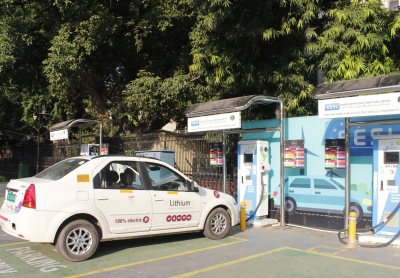
New Delhi, Dec 15 Battery electric vehicles (BEVs) significantly outperform petrol‑powered internal combustion engine vehicles (ICEVs) in reducing greenhouse gas emissions over their full lifecycle, a report said on Monday.
The operational emissions for an ICEV are at 53.84 tonnes of CO2e (Carbon Dioxide Equivalent) versus 33 tonnes for a BEV on India’s current grid with 28 per cent renewables, said the report from the Centre for Excellence in Energy and Telecommunications, Indian Institute of Technology Madras and Immersive Technology and Entrepreneurship Labs.
With fully renewable electricity, BEV operational emissions drop to a negligible 0.03 tonnes, the report highlighted.
Using a dynamic lifecycle model over a standard lakh‑kilometre lifespan, the study found that manufacturing emissions without renewables or recycling were 8.66 tonnes for ICEVs and 9.66 tonnes for BEVs.
However, with 100 per cent renewable energy and recycling, these figures drop dramatically to 2.89 tonnes for ICEVs and 2.54 tonnes for BEVs, giving BEVs a clear advantage
BEVs convert around 90 per cent of electricity into traction energy, compared to less than 25 per cent for petrol engines. This inherent efficiency advantage further reduces overall energy demand and associated emissions.
The report projected that by 2040, advanced recycling could recover up to 95 per cent of key materials and cut manufacturing emissions by 30-40 per cent. In contrast, ICEVs are fundamentally constrained by their carbon-intensive combustion process, with about 80 per cent of their lifecycle emissions occurring during operation and limited potential for efficiency improvements.
“This study arrives at a moment when India can no longer afford to delay decisive action on transportation emissions. BEVs are not just marginally better, they are decisively superior to petrol vehicles in reducing greenhouse gas emissions, even with our current electricity mix," said Dr Ashok Jhunjhunwala, Chairman, Immersive Technology and Entrepreneurship Labs.
The report emphasised that the transition to EVs must go together with moving electricity generation to renewables and complete recycling of all subsystems of a vehicle, including the battery.
Disclaimer: This post has been auto-published from an agency feed without any modifications to the text and has not been reviewed by an editor
Open in app